
A proposal for COP30: How to create Forest Friendly Food Politics
15 Oktober 2025
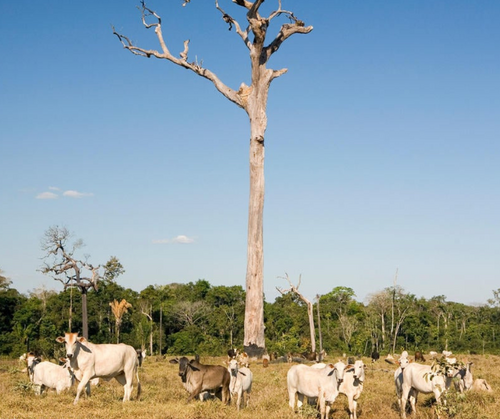
According to the UN’s Food and Agriculture Organization, agricultural expansion causes 90% of all deforestation worldwide, driven mainly by the production of meat from grazing cattle and of soy sold as fodder for farmed animals. Animal production causes the loss of more than 16.4 million trees each day. Denmark is not without blame: our highly industrialised production of pigs, poultry and cows for dairy pollutes our fjords and drinking water and contributes to deforestation in the Amazon. But Denmark has made an important stride towards positive change.
With its six million inhabitants, Denmark produces more meat per capita than any other country in the world: an estimated 30 million pigs per year. Yet Denmark has chosen to encourage a dietary shift by being the first country in the world to adopt a Plant-Based Food Grant and an Action Plan for Plant-Based Foods. By contrast, the European Commission chose to side-step the issue in its Vision for Agriculture and Food, despite the recommendation “to re-balance towards plant-based options” from its own Strategic Dialogue (FW 303).
Denmark’s Action Plan and Grant were supported by a wide range of political parties in the Parliament, setting a strategic direction for the production and consumption of plant-based foods in Denmark, with financial support to back it. Several initiatives to build bridges across the food value chain and support among farmers, industry organisations and green organisations preceded the Grant and the Action Plan. This was groundbreaking and noticed in many countries inside and outside of Europe that wished to understand how Denmark, a top meat-producing country, was able to create and support these plant-based initiatives – without triggering protests in the streets.
This is why we have formed a collaboration called Danish Plant-Based Diplomacy, together with the Food and Agriculture Council (the largest representative for farmers and food producers in Denmark), the Danish Chamber of Commerce, the Danish Food and Drink Federation, the Danish Plant-Based Business Association, Organic Denmark, Think Tank Frej and LandboUngdom. Our purpose is to tell the Danish story, inform about the Danish initiatives and inspire other EU countries to work towards similar action plans and funding.
Besides developing a strong domestic value chain and consumption of plant-based foods, the Danish Action Plan also encourages initiatives that work towards increasing a more plant-based diet internationally. The Danish Government currently holds the EU Council Presidency and has added the ambition of creating a European Action Plan for Plant-Based Foods in its programme.
In November, Danish Plant-Based Diplomacy will take its approach to UNFCCC COP30, aiming to inspire government representatives, NGOs and farmers all over the world. We will host several side-events sharing the Danish initiatives and our experiences of creating connections among unlikely allies. Because if Denmark can do it, everyone can do it.
In addition, we also wish to bring a new idea to the table at COP30 in Belém, where Brazil will launch its Tropical Forest Forever Facility (TFFF; see FW 306). This funding mechanism encourages investors to place their money for the long term. Its aim is to place US$100 billion in investments to achieve a steady revenue. Investors are promised a set return over 20 years, and excess revenues will be used to pay forested countries for keeping their forests standing.
Although this funding mechanism promotes a different way of directing money towards the important purpose of saving forests, the Facility does not address the main drivers of deforestation – a significant challenge for its ability to successfully prevent deforestation. We believe that if you do not actively remove the huge pressure on forests, and remove the main drivers of deforestation, you will not succeed in stopping the forest from being cut down.
To address this challenge, we suggest that a TFFF should be accompanied by a GFFFF: a Global Forest Friendly Foods Fund. Much like the Danish Plant-Based Food Grant, it should support the transformation in all parts of the supply chain, including the education of kitchen professionals, the re-introduction of traditional meals with legumes, and by developing new high-protein, low-impact crops and products, and making these available to consumers at all levels of society.
Details about how a GFFFF should be structured or where it is best located remain to be worked out. But we at the Vegetarian Society of Denmark look forward to engaging with and talking to a broad range of people at COP30 about its needs, possibilities, and ideas for governance and design. And there is no reason why the EU should not be the first contributor to a Global Forest Friendly Food Fund, focussing on relieving the pressure on the forests of world.
Image: Werner Rudhart/Greenpeace
Kategorien: Forest Watch, Partner Voices, European forests, Meat consumption