A sector transformed
4 November 2025
Ghana is the first country in Africa to be awarded a coveted FLEGT licence - seen as the gold standard in the fight against illegal logging. But will it be the last? Author and Fern board member Fred Pearce reports on how the fate of many of Africa’s surviving forests could depend on its success.
Ghana has become the first African country to win fast-lane access to European Union markets for its timber. A trading licence negotiated with the European Commission over 16 years means all logging in the West African country is recognised as untainted by illegality and carried out with the consent of nearby forest communities, who are compensated in cash or kind.
Armed with the licence, traders can sell Ghanaian timber to Europe without further checks on its legality, with the first batch entering the European market on October 8.
The Forest Law Enforcement, Governance and Trade (FLEGT) licence - among a series of measures introduced by the EU more than 20 years ago to tackle the root causes of illegal logging - has widespread support from industry and civil society in Ghana, as do the national rules on forestry and timber tracking and trading that underpin it.
Richard Nsenkyire, managing director of Samartex Timber and Plywood, one of the country’s leading timber exporters, says the license marks “the beginning of a new era in compliant international trade” for Ghana, which “will guarantee access to the EU market”.
Under the new regime, trees can only be felled in designated areas according to agreed volumes. Logging is banned in protected areas, those of global biodiversity importance, and on steep slopes or close to water bodies. “This is real progress in sustainable forest management,” says Albert Katako, head of programmes at Civic Response, a Ghanaian resource-rights advocacy group heavily involved in drawing up the plans.
“And it isn’t just about trees – it’s about people,” he says. Historically, the marginalised communities living in the vicinity of logging operations would see their forests razed but none of the profits from it. Now, Katako says, “timber companies [must] reinvest in local communities, so they see real benefits from logging.” Timber companies must negotiate Social Responsibility Agreements (SRAs) with communities within five kilometres of their concessions and pay them royalties. More than a hundred such agreements have been negotiated to date.
The harmony over how to manage the nation’s forests is more than skin deep, says Saskia Ozinga, co-founder of Brussels-based forests NGO Fern, who has watched the development of the laws. The long process “has led to cultural change in which the Forestry Commission and critical NGOs worked together – in stark contrast to the beginning when they were at loggerheads and cooperation seemed impossible.”
Transformational
Ghana’s FLEGT licence has been issued under the terms of a timber trade pact with the EU known as the Voluntary Partnership Agreement (VPA), signed in 2009, which requires exporters to demonstrate the sustainability and legality of each timber shipment. The licence reduces bureaucracy dramatically, all processes – such as tree geoposition data to prove lack of deforestation – are now done electronically.
The licence is underpinned by a tracking regime known as the Timber Legality Assurance System (TLAS).
Hugh Brown, CEO of the Ghana Forestry Commission, says this provides “an accountability chain… from the tree stump site in the forest, through transportation, processing to export that ensures every action is traceable.” The transformational change to forest administration has “fundamentally reshaped how we manage, monitor and make decisions about our forest resources,” he says.
The electronic tracking system is backed up with audits by inspectors and an independent monitor. A publicly available online portal developed by Civic Response in collaboration with the Forestry Commission, allows any Ghanaian or international stakeholder to monitor timber flows across the country.
Brexit complication
Ghana is only the second country anywhere to be granted a FLEGT licence, after Indonesia in 2016. “The initiative is essential for sustainable forest management, rooted in traceability, which guarantees that timber exported to Europe is harvested, processed, and sold through lawful channels,” said the then-EU ambassador to Ghana, Irchad Razaaly, heralding the signing of the agreement. “It establishes an environment ripe for genuine, long-term investments that not only boost Ghana’s economy but also create enduring job opportunities.”
The 16 years it took to reach a deal “is partly due to the inclusiveness of all the relevant stakeholders to develop trust [and] build a robust system,” says Doreen Asumang-Yeboah, director of the Rights and Advocacy Initiatives Network, a Ghanaian resource-rights NGO.
But it has been worth it, says Charlie Bosworth, strategy director of Miro Forestry, which operates Forest Stewardship Council-certified (FSC) plantation forests and plywood mills in Ghana. “The FLEGT framework demonstrates Ghana’s long-term commitment to sustainable forest management,” he says. “It is great news for Ghana, but also for anyone who cares about the plight of the world’s forests and tackling illegal deforestation,” agrees David Hopkins, chief executive of Timber Development UK, which represents British timber suppliers.
It is not yet clear, however, whether importing countries outside the EU will give Ghanaian timber the same fast-track access as Brussels. The standout case is the UK. Both before and since leaving the EU, the British government has provided Ghana with technical assistance to travel the road to FLEGT licensing. But the certificate itself was issued after Brexit, which raises legal difficulties.
“The UK legal departments seem to have tied themselves in knots over whether or not it can be legally accepted without a new formal VPA agreement between UK and Ghana,” says Hopkins. He calls such vacillation “hugely frustrating – and faintly ridiculous.”
Illegal operators
Other observers of Ghana’s FLEGT process are concerned about whether Ghana can achieve its promise to successfully apply the timber-tracking rules to the domestic market. A three-tier timber industry has long existed in the country: A handful of large companies process logs for export at sawmills; other legal companies supply some of the domestic market; and a substantial tier of small rural gangs armed with chainsaws cut trees illegally and saw them into planks in the forest, before sending them to local markets.
This chainsaw-milled timber makes everything from major government infrastructure to the furniture on sale at hundreds of roadside stalls across the country. Yet, despite being vital to national life, most Ghana chainsaw millers have operated illegally since 1998, when the government banned the activity.
As recently as 2018, the gangs were reckoned to employ as many as 100,000 people and sustain the lives of many times more. A study for the Centre for International Forestry Research in 2022 warned that traders in lumber markets across the country “would lose their livelihoods if illegal timber were to be reduced, which might generate social problems.”
Asumang-Yeboah says NGOs have made big efforts to legalise chainsaw millers by training them to operate mobile sawmills that would be legal if processing legally cut timber. Mustapha Seidu, director of the Nature and Development Foundation, which has been carrying out training, says he can’t estimate how many chainsaw millers are still in business, but “it is reasonable to suggest that a lot of them have converted to using mobile sawmills.” He says there is still a market for illegal timber, however, “because of indiscriminate consumers, including the government.”
The government has granted small areas of forest for the use of small-scale millers. But there remains a danger that illicit, untracked timber in local markets could leak into international trade and undermine the FLEGT licence. However, Seidu hopes the reverse will happen -- that FLEGT will change the market and cut off illegal supplies. “We hope this will be the icing on the cake for the FLEGT process.”
Shifting threats
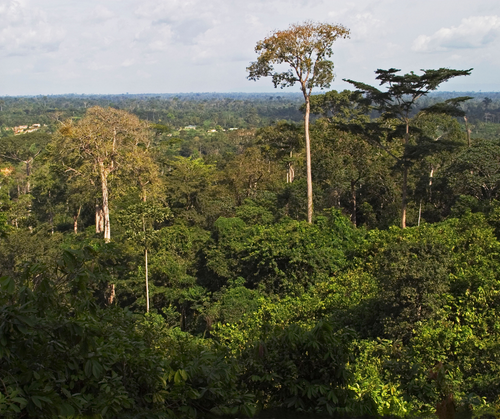
Ghana has around eight million hectares of forests, covering around a third of the country, according to the UN Food and Agriculture Organisation. Some 2.6 million hectares of these are dedicated to timber production, with half the total lumber output going for export.
In the past quarter-century, about 14% of the country’s forests have been lost, according to Global Forest Watch, an independent online platform. However, the largest cause of deforestation is no longer forestry. It is clearance for agriculture -- often to grow commodity crops such as cocoa, for which Ghana is currently the second largest exporter.
Europe’s contribution to these losses could be addressed by the EU Deforestation Regulation (EUDR), which will require importers to show that major commodity crops, including cocoa, imported to Europe are grown legally and without causing deforestation – although the Commission now wants to delay the regulation for a second time, and its future is uncertain.
Another growing concern is a recent boom in illegal gold mining in Ghana. The country is the world’s sixth largest exporter of gold, much of from illegal mines in the forests. More than a tenth of the country’s forest reserves are impacted, according to the Forestry Commission.
Even so, and whatever the pitfalls, outsiders hail the transformation of forest governance that underpins the country’s FLEGT licence. “Ghana should be rewarded for putting in place such a robust and sustainable framework for forest management and timber production,” says Hopkins. “Hopefully this will act as an incentive for other countries to improve and implement their own national forestry systems.”
But will Ghana become a model for others? The evidence is that forests are best protected when markets demand it, and here Europe appears to be taking a step backwards. The EU has become reluctant to embroil itself in further protracted negotiations on how forests are managed on other continents. Late last year, the Commission announced unilateral plans to terminate two of its African VPAs, in Cameroon and Liberia. The Cameroon VPA was cancelled this summer. The Commission says it wants to replace VPAs with looser non-binding trade arrangements.
This has provoked anger in Africa. The former president of Liberia, Ellen Johnson Sirleaf, warned in May that axing her country’s VPA would seriously undermine its efforts to end illegal logging. “Without recognition in markets that give importance to compliance with our regulations, we are worried that the illegal timber trade will once again take root,” she said.
There are fears that the FLEGT licence issued for Ghana, the first in Africa, could also turn out to be the last. That would snatch defeat from the jaws of a famous victory. But there is also hope that Ghana’s groundbreaking system of timber traceability could help spur similar systems in other countries and perhaps be adopted for other commodities associated with deforestation, such as cocoa and coffee. The fate of many of Africa’s surviving forests could depend on the outcome.
An abridged version of this article appeared in Mongabay.
Kategorien: EU Partnerships, Illegal logging, Ghana