Could the EU Deforestation Regulation be a gamechanger for women cocoa producers in Cameroon and Republic of Congo?
4 März 2026
Harms linked to cocoa production – deforestation, child labour, farmers not paid a living wage – have long been documented, especially in Côte d’Ivoire and Ghana, the world’s two leading cocoa producers. Recent studies by Fern partners offer new insights into the impacts elsewhere: in Cameroon, the fourth-largest producer, and the Republic of the Congo (RoC), where 2004 and 2005’s record prices pushed a surge in cocoa farming. The studies show that the EU Deforestation Regulation (EUDR) could be crucial tool in creating a positive social and environmental shift.
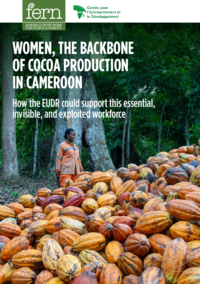
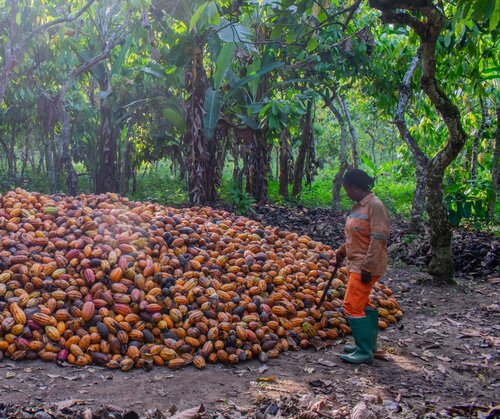
Cameroon and women’s rights: Supported by Fern, the NGO Centre for Environment and Development carried out 10 field studies across three regions of Cameroon, leading to the report, Women, the backbone of cocoa production in Cameroon’s cocoa sector, which highlights women’s central role, the invisibility of women’s work and the violence and injustices linked to it. Women are charged with maintenance and harvesting, but property rights, revenue and decision-making remain with men - 87% of women producers in the localities studied experience land insecurity. Indigenous Baka women are most vulnerable and marginalised, often victims of land grabbing or confined to low-paid labour on third-party plantations. Hostility from local men constrains women’s access to information, production inputs and labour; women are sidelined in cooperatives, and have limited access to training programmes, credit and technical support.
EUDR implementation and international support to sustainable Cameroonian cocoa should focus on empowering women, and particularly Indigenous Peoples. Key priorities are including women producers in the national traceability system, supporting them to secure land rights, providing training and technical assistance, and encouraging zero-deforestation agroecology practices. Cocoa companies also have a central responsibility actively to support smallholders – especially women – and should fulfil their legal obligations (EUDR, Art. 11) to mitigate risks by meeting producers’ needs: providing women with appropriate information, ownership of geolocation data, training, and support to set up strong and effective cooperatives.
This becomes ever-more essential as Cameroon pursues the conflicting ambitions of maintaining its 2021 commitment to “Zero Deforestation Cocoa” and of doubling cocoa production by 2030 – noting that most land available to increase production is forested.
RoC: Brazzaville-based NGO Forum pour la Gouvernance et les Droits de l’Homme works with forest communities who have seen high international cocoa prices jump-start a dormant cocoa industry aimed largely at export to the EU. It examined cocoa production in Likouala, Sangha and Cuvette provinces, where slash-and-burn methods are being used to clear forests to plant cocoa – unknowingly disqualifying that cocoa from being imported into the EU, as commodities produced on land cleared after 31 December 2020 cannot be considered deforestation free. In addition, cocoa plants fare better if cultivated in semi-shade. The study found use of child labour, and discrimination towards women and Indigenous Peoples, especially through restricted access to land. Wholesalers have too much leeway to impose exclusive contracts at low prices, and to move cocoa illegally across borders.
Preparation for EUDR compliance could push development of a national traceability system which would support cocoa producers in cooperatives to share best agricultural practice for ‘sustainable, climate-smart’ cultivation, and much-needed information about the legal framework for export.
Cocoa production’s harms cross countries as large chocolate company profits do not translate into living wages for famers. EU citizens have consistently indicated that they do not wish to be a party to the deforestation linked to their consumption (87% in 2019; 84% in 2024). Implementing a strong and ambitious EUDR would uphold European values like environmental sustainability, social justice and women’s rights. But private, commercial interests keep attacking the EUDR, trapping it in a downward spiral of repeated delays (FW 302; FW 310); an upcoming ‘review’ of EUDR obligations is poised to further diminish ambition. The Commission must ensure that this review does not come at the expense of women, forests and the public interest.
Kategorien: News, Forest Watch, EU Regulation on deforestation-free products, Cameroon, The Republic of Congo