Deforestation and Nature Restoration Regulations: necessary, yet under threat
17 September 2025
In the dead of summer, the Commission launched a number of consultations, many of which targeted environmental legislation, and would empty rules of meaningful requirements. Opposing camps lined up accordingly, flooding the zone.
But massive fires, killer heatwaves, droughts, crop failures, and “centennial” floods that return with increasing frequency cannot be ‘simplified’ out of existence; these problems will worsen, costing future generations dearly. For forests, two existing regulations, the EU Deforestation Regulation (EUDR) and the Nature Restoration Regulation (NRR), should be particularly shielded from attack.
EU Deforestation Regulation: In light of continued forest loss, the EUDR is increasingly essential to forest peoples, to the climate, and to global biodiversity. Adopted after EU consumers, and consequently EU Institutions, expressed their wish for our consumption to avoid driving global forest loss, its implementation has already been delayed by one year. A vehement segment of Europe’s private sector is now pushing to add a ‘zero-risk’ deforestation category that would broadly exempt them from any effort to improve current practices.
But tropical forest loss has almost doubled since 2023, pushing the 1.5°C Paris Agreement climate target further from reach, intensifying wildfires and extreme weather events, and endangering us all. World leaders’ promise to end and reverse deforestation by 2030 seems disingenuous in this context.
As adopted, the EUDR allows for three categories of risk, already criticised as overly lenient (FW 306). To introduce a ‘no risk’ category undermines the good faith efforts made by producer nations and many responsible companies that have been preparing for implementation. EU timber companies, among the EUDR’s most strident opponents, should have little trouble adjusting to the EUDR as they are already subject to similar obligations under the EU Timber Regulation. The EUDR adds little burden beyond geolocation of forest plots and due diligence statements. In addition, the EUDR already features simplifications for downstream market traders and small and medium sized enterprises.
Commercial interests require certainty and predictability to thrive. Constant upheaval must be brought to a halt, and the existing implementation timelines maintained.
Adopted in 2024, the Nature Restoration Regulation (NRR) was welcomed as a compromise text that emerged from Trilogues with its scientific integrity intact (FW 293), particularly as concerns forest-health indicators. Recently, even the NRR has come under attack: vociferous groups of forest owners claim that it conflicts with ownership rights and call for it to be scrapped altogether.
Ownership has never been a laissez-passer to unbridled irresponsibility. We should not forget that Europe’s forests are in a critical state: only 14% of EU forest habitats have favourable conservation status, and of 233 forests, 187 have ‘unfavourable’ status. Many are so degraded that they can no longer fulfil carbon sequestration functions.
Industrial forest management in Europe is also failing economically: EUROSTAT reports that forestry employment has dropped by 10% from 2012-2023, and intensive practices are propped up by forest subsidies estimated at €5.8 billion annually.
Amid the noise, it is useful to recall that many foresters argued in favour of the NRR during its adoption, and many have expressed interest in shifting towards close-to-nature (CNF) management, but lack the initial funding needed to transition from clear-felling to CNF harvesting which is more stable, and benefits climate, nature and communities in the long term. Recent research commissioned by Fern specifically identifies harmful EU subsidies that could be redirected towards supporting restoration practices and assisting their shift to CNF methods.
As is, the NRR offers the opportunity to set up time-bound restoration targets for all forest ecosystems that respect comprehensive, flexible biodiversity indicators measuring composition, structure and function, eliminating harmful subsidies, and making resources available to forest owners and managers to undertake restoration practices by 2030.
When private commercial interests are prioritised over the common good, it is counter-productive, driving a race to dismantle crucial environmental protections that save billions – in any currency – each year. The deadly fires and heat of Europe’s summer must remind us all of these regulations’ fundamental necessity, and motivate the Commission to clearly indicate that it will not entertain further disruptive calls to empty existing EU law of all purpose.
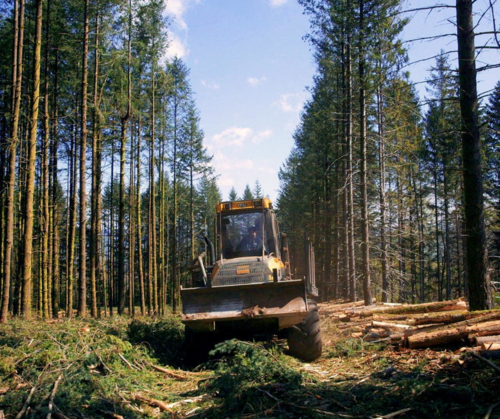
Image: Fern
Kategorien: News, Forest Watch, European forests, EU Regulation on deforestation-free products