From pledges to progress? Forest commitments on the path to COP30
8 Mai 2025
Despite the US leaving the Paris Agreement and the increasing difficulty in achieving global unity about anything, hope will be in the air when scientists, NGOs and government climate experts come together, 16 - 26 June 2025, for session 62 of the Subsidiary Body for Scientific and Technological Advice (SB 62) of the United Nations Framework Convention on Climate Change (UNFCCC). As usual, the meeting will take place in Bonn, Germany.
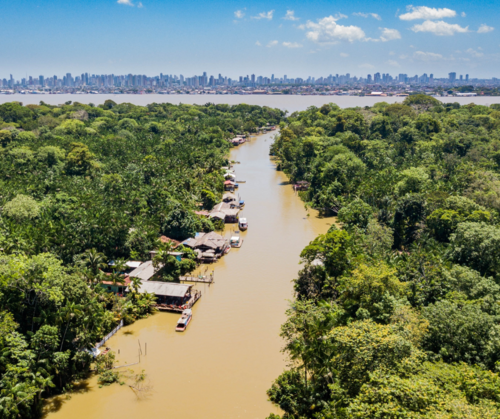
SB 62 participants will attempt to get on the same page about what is needed from the upcoming 30th Conference of the Parties of the UNFCCC (COP30) in Belem, Brazil, being dubbed “the Forest COP”.
Forest campaigners’ interest in COPs had waned as the petro-states of Saudi Arabia and Azerbaijan took the reins, but now see the possibility that something of note can be achieved. Fern is therefore taking this opportunity to look at promises made in the last four COPs and progress towards delivery, examining official COP decisions as well as important forest announcements not tied to the UNFCCC process. (In recent years, formal negotiations have focussed less on forests, but announcements and initiatives have proliferated on the sidelines.)
COP29 in Baku, Azerbaijan, was most notably the venue for agreements on global carbon market rules under Article 6 of the Paris Agreement. This may seem far from forests, but many carbon offset projects are based on forested land, often grabbed from Indigenous Peoples and local communities. Carbon-trading slows progress on emissions reductions by allowing industries to claim to ‘offset’ rather than reduce their emissions – despite the many well-sourced examples of offsets doing more harm than good. Offset projects under Article 6 can include emission removals, which puts further focus on forest projects, although avoided emissions are currently not included.
COP29 also focussed on who would finance previous agreements. Developed nations, including the EU, pledged the “New Collective Quantified Goal” to mobilise US$300 billion of climate finance annually – three times the previous US$100 billion mandate, but far below the US$1.3 trillion experts identify as the bare minimum needed. The World Resources Institute has shown that the funding target is within reach and outlines how to get there. Progress will be measured as part of the Enhanced Transparency Framework.
At COP28 in Dubai, parties agreed the “UAE Consensus” package, which included the aim to equitably “transition away” from fossil fuels, and to halt and reverse deforestation and forest degradation by 2030. This was the first commitment in a global treaty to end deforestation and it emphasised the importance of conserving, protecting and restoring nature and ecosystems. With 3.7 million hectares of tropical primary forests lost in 2023, it is hard to say that this commitment is on track.
COP28’s crossover with the Biodiversity COP in the Joint Statement on Climate, Nature and People was welcome, though it promised little beyond sharing information and meeting regularly. Whether even this meagre aim has been achieved is questionable, as continued interest in monoculture plantations rather than restoring and protecting forests shows a lack of understanding of the interconnected nature of climate change and biodiversity loss.
Brazil’s Minister for Environment and Climate Change used COP28 to propose the US$250 billion “Tropical Forest Forever Fund” (TFFF), which now has a sister initiative: the Tropical Forest Mechanism. Both are complex attempts to get funds to forested countries for not deforesting, something that has been discussed for decades as Reduced Emissions from Deforestation and Degradation (REDD). Expectations are high that the TFFF will be launched at COP30, bringing much-needed momentum to finance for tropical forest conservation, but questions remain around how degradation will be monitored and the extent to which Indigenous communities will be able to directly access payments.
The Forest and Climate Leaders Partnership (FCLP) also announced a series of country packages, including with Papua New Guinea and the two Congos. One of its aims is to ensure accountability for commitments made under the Glasgow Leaders’ Declaration on Forests and Land Use (GLD) – so it is disappointing to note that fewer than a quarter of the original countries signed up.
Progress of the Amazon Roadmap, also launched at COP28, is hard to assess, as it has little in the way of measurable goals or timeframes towards the 2030 aim of ending deforestation. It is possible to say, however, that deforestation in the Amazon has dropped to its lowest level in nine years, although forest degradation has skyrocketed.
COP27 in Sharm el-Sheikh saw an historic breakthrough in establishing a new fund for Loss and Damage, part of the Sharm el-Sheikh Implementation Plan. The World Bank has since agreed to host the fund, and US$700 million has been pledged – sadly a drop in the ocean, compared to the US$580 billion in climate-related damages that vulnerable countries are expected to experience by 2030. Other parts of the Plan, such as “immediate, deep, rapid and sustained reductions in global greenhouse gas emission”, have clearly not been met.
Brazilian president Luiz Inácio Lula da Silva used the COP to recommit Brazil to zero deforestation and degradation (it has reduced but is far from zero), pledged to create a ministry of Indigenous and native peoples (done), and proposed to host the 2025 COP in Brazil (on its way). The Amazon Fund (a REDD initiative frozen during Bolsonaro’s Presidency) was reinvigorated following a meeting between President Lula and Norway’s environment minister. Lula called on the US to also contribute, which they initially did (along with others) but future US funding seems unlikely. The fund’s overall budget is nearing US$1 billion.
At COP26 in Scotland, the Glasgow Leaders Declaration on Forests and Land Use, pledged to end and reverse forest loss by 2030, supported by the US$12 billion Global Forest Finance Pledge (GFFP). This commitment was reaffirmed at COP27 and the most recent update is here. As of 2023, they were making steady progress and 77% (US$10 billion) had been directed to forested countries.
The Mitigation Work Programme, launched at COP26, has been criticised for a lack of ambition, but it is still important given that in 2024 we already passed the overall goal of keeping global heating below 1.5°C. Finally, the Forests, Agriculture Commodities and Trade (FACT) dialogue was announced, whose aim is to promote sustainable development and trade while protecting forests. FACT is chaired by Indonesia and the United Kingdom and involves 28 countries (the EU is ‘one’). It has been supportive of important new regulations such as the EU Deforestation Regulation.
Image: Viagens e Caminhos/Shutterstock
Kategorien: News, Forest Watch, Finance for forests and peoples, Brazil