Is this the end for meaningful forest monitoring?
17 September 2025
The turmoil that for the past year has surrounded the EU’s draft legislative text on Forest Monitoring shows no signs of abating.
On 23 September 2025, the ENVI committee will vote on the Forest Monitoring proposal; in early September, the Socialists and Democrats (S&D), Renew Europe (RENEW) and European People’s Party (EPP) coalition that intended to agree on compromise amendments fell apart. The coalition had previously coalesced around shaky foundations, with the committee draft report losing sight of the poor state of European forests, and the need to assess this accurately in order to protect them more effectively.
Even without insisting on obvious climate and biodiversity functions, the need for strong, harmonised forest data is clear. Rising threats to forest health also threaten the forestry industry’s bottom line; over recent decades, wind, fires and insect damage have been increasing, incurring losses equalling some 16% of what is harvested annually (FW 299). Incomplete, out-of-date information hinders appropriate responses to such threats: National Forest Inventories must be updated only every five to 10 years, and criteria vary across Member States.
More ominously, forests’ capacity to sequester carbon is dwindling (Sweden, France) and some have even shifted to emitters of carbon dioxide (e.g., Germany, Estonia, Finland). Without timely, comparable data, it is difficult to grasp what is behind these results.
Nor should complaints about additional monitoring burdens be a reason to remove Earth observation obligations: Data from the EU’s Copernicus satellite could offer free information to forest owners, avoiding the need source remote-sensing data privately.
But logic seemingly has little to do with current political battles (FW 304), and it now appears likely that Earth observation data requirements will be dropped from the draft, undermining its purpose.
And from here?
With a vote in the Environment Committee looming and a rupture of the brief alliance between Socialists and Democrats (S&D), liberals (RENEW) and conservatives (EPP), S&D and RENEW are calling on more reasonable EPP members to ignore their party’s decision to step out of negotiations, but they also must make sure that a coalition is gathered around a proposal worth defending.
To ensure minimal effectiveness, the proposal must mandate science-based data collection – meaning that Member States must be obligated to send data to the EU to ‘ground-truth’ the satellite data – and they must accurately show the impacts of harvesting across EU forests. An open letter (February 2025) signed by almost 80 scientists and academics, with support from the European Association of Remote Sensing Companies (EARSC), gives further details for consideration.
For their part, the EPP and the far-right may propose other amendments that diminish the file’s purpose, or even call to reject the proposal altogether on 23 September – an opportunity to place blame on them for destroying another promising EU environmental rule while offering cover for those who failed to defend the file.
Until then, S&D and Renew should call for a Forest Monitoring Law that achieves its intended purpose: New, more accurate information on our forests, and that starts with defending robust data collection, tracking logging to see what helps and what hinders forest resilience, and tracking changes to biodiversity. If progressives cannot defend the need for this information across EU forests, then the entire Parliament must take responsibility for destroying the opportunity this law represents.
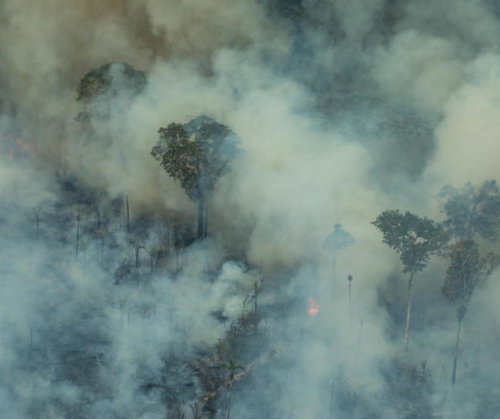
Image: Victor Moriyama/Greenpeace
Kategorien: News, Forest Watch, European forests, EU Regulation on deforestation-free products, Forest conservation