A critical threat
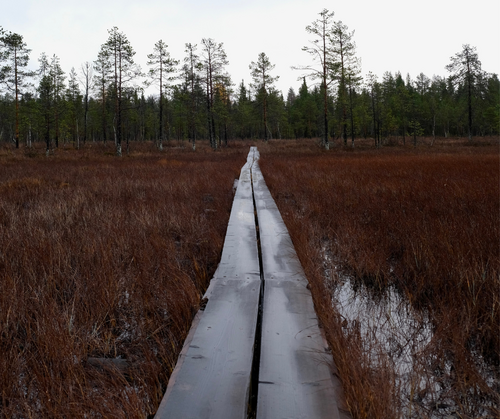
In Finnish Lapland, an ecosystem that’s evolved over thousands of years is threatened with destruction for the short-term needs of the car, defence and AI industries. Now the Sakatti mine has moved a step closer to opening, and environmental defenders in Finland are mobilising, writes Perrine Fournier.
Viiankiaapa’s remote, vast marshlands lie 150 kilometres north of the Arctic circle in Finnish Lapland, and is home to a precious ecosystem, teeming with rare and endangered birds and plants.
This is a Natura 2000 site: part of the largest network of protected areas in the world, established by the EU to offer a haven for Europe’s most valuable species and habitats.
But this protection - as well as that provided by Finland’s national mire conservation programme - could soon dissolve in the face of economic and geopolitical pressures.
Beneath Viiankiaapa’s rich peat bog ecosystem are deposits of copper, platinum group metals and nickel: materials expected to be used for electric vehicles, wind turbines, weapons systems and artificial intelligence (AI). Anglo American has been exploring the site since 2004, naming the project Sakatti. It plans to start extracting raw materials there from the early 2030s.
Sakatti was among the 47 EU sites chosen last year by the European Commission as Strategic Projects.
In its desperation to secure a supply of the critical raw materials needed for the clean energy and digital transitions, as well as for weapons systems, procedures for mining for key metals and minerals in these sites will be streamlined.
Last month, the mine moved a step closer to opening when the Regional Council of Lapland decided to request that Finland’s Environment Ministry exempt the site from the protections afforded by its Natura status.
Around the same time, serious doubts emerged about the Commission’s selection process for these sites.
The German intelligence outlet Table.Briefings revealed that the Commission disregarded expert advice when making its decisions. The publication reported that several environmentally and socially controversial projects were added to the list in the first selection round in 2025 after they’d failed to meet expert assessments two weeks before: “raising questions about the methodological integrity and credibility of the selection process”.
But it is not just the sites which were deemed to fall short of the requisite criteria which are controversial. The Sakatti project was not among them, despite, as its critics point out, it threatening to destroy an ecosystem that’s evolved over thousands of years for the short-term needs of the car and defence industries.
This follows a global pattern - from Indonesia to the Democratic Republic of Congo (DRC), and elsewhere - in which the scramble for critical raw materials is driving environmental and human rights abuses.
Dangerous precedent
The Sakatti mine, its opponents say, threatens the credibility of Finnish nature conservation.
“If that mine’s established, it would open the way for other mining companies or other industries to enter areas which are meant for nature conservation,” says Mikko Sipilä, a Professor at the Institute for Atmospheric and Earth System Research at University of Helsinki and a member of the local Sodankylä Municipality Council.
The municipality of Sodankylä lies 15 kilometres north of Viiankiaapa, and most local residents support mining, even in ecologically precious sites.
Yet according to Sipilä’s research, claims regarding the exceptional nature of Viiankiaapa’s deposits are overblown. Sipilä calculates that indicated resources of the mine’s largest product, copper, would satisfy global demand for just three days.
One person has probably done more than anyone to raise awareness of the threat the Sakatti mine poses: Riikka Karppinen, an environmental activist whose father is a miner, and who has been a member of Sodankylä’s municipal parliament for 12 years.
At 15, she began campaigning against mineral exploration in Viiankiaapa, writing to Finnish politicians, visiting the Parliament in Helsinki, and attracting international coverage for the cause.
“It’s not that we would like to stop forestry and mining here, but it’s about better regulation for these big industries. Lapland has always been the place where big companies come and take natural resources from us,” she says.
Viola Ukkola, a 23-year-old reindeer herder and academic, agrees.
“In Sodankylä, we have this case of the resource curse: when the place becomes dependent on one resource,” she says, referring to locals’ heavy reliance on mining for their livelihoods.
Ukkola is steeped in a reindeer herding tradition that stretches back generations in her family, and which she absorbed from a young age from her grandparents.
The Sakatti mine will be situated on land next to where Ukkola Cooperative’s reindeers graze, and dust and pollution from the mine will affect the growth of lichen that reindeers feed off, Ukkola says, threatening local herders’ livelihoods.
The impact will be even worse for their neighbouring Oraniemi [reindeer] Cooperative, as the mine will located on their lands.
“As reindeer herders, we feel our voices have not been heard. Our suggestions have not been considered in the environmental impact assessment [for the mine],” says Ukkola.
Reduce demand
One way to stop mining for critical raw materials in ecologically rich places around the world is by establishing ‘no-go zones’.
Yet in Viiankiaapa, both Finnish law and its Natura 2000 status has so far not been able to provide protection.
Another solution, laid out in great detail - specifically in the EU context - by researchers earlier this year, is reducing our reliance on the critical raw materials used to power electric vehicles (EVs), through limiting car and battery size, promoting alternative batteries and soft transport solutions, such as car sharing and promoting public transport.
Meanwhile, the legal battle over the Sakatti mine is hotting up.
The Regional Council of Lapland, which is preparing the land use plan for the mine, recently decided to submit a request to the Ministry of Environment and its Minister Sari Multala to prepare a proposal for the Finnish Government to grant the Natura exemption required for approving the land use plans, and ultimately enabling the opening of the mine.
The matter is now in the hands of Minister Multala, and the proposal could be brought to the Government for decision-making in the autumn.
If the government decides to grant that Natura derogation, the decision will be naturally challenged and taken to the Supreme Administrative Court.
“We are going to appeal to every court that we can,” says Sisli Piisilä, an environmental engineer and the Executive Director of the Suomen luonnonsuojeluliitto (Finnish Association for Nature Conservation) in the Lapland region, who is involved with a number of court complaints and appeals over mining’s destructive impact on nature and the Sámi.
The battle to protect Viiankiaapa is far from done.
Its outcome could have implications for other strategically important raw material sites in Finland, and beyond.
Categorías: News, Critical minerals