As cocoa farmers suffer yet another “boom and bust” price cycle, EUDR and Schedule 17 could help
1 abril 2026
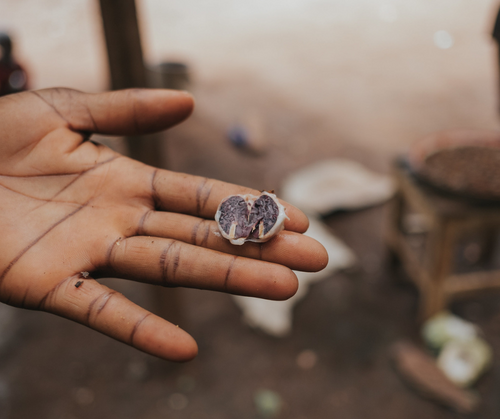
After reaching historic highs in 2024 and early 2025 – when cocoa was dubbed “better than bitcoin” – cocoa prices recently crashed again, leaving farmers in distress.
Implementation of anti-deforestation legislation led by the EU and the UK could send a market signal that restrains new deforestation, thereby helping to stabilise prices and to lift smallholders from extreme poverty.
The cocoa market has been historically marked by “boom and bust” cycles that leave farmers exposed and unable to plan over the long term or to invest in their plantations. As a result, a majority of African small-scale farmers still live below the extreme poverty line.
In Cameroon, where the market is unregulated, prices collapsed from 5,000 CFA francs per kilo to 700 CFA. Fern partners have alerted us that plantations are being destroyed.
In Côte d’Ivoire, the cocoa market is regulated, and prices announced in October 2025 for the main harvest season were historically high, to the satisfaction of farmers. But with sudden international market price drops, farmers have been unable to sell at the set price, thereby missing their main revenue stream for the year. The Ivoirian regulator has promised to buy unsold cocoa but, according to interviews with cooperative representatives in March, this has not yet happened on a large scale.
Cocoa production has historically relied on heavy deforestation. A complicated crop to grow, it thrives in healthy rich soils, which can be found on recently deforested land. As a result, Côte d’Ivoire and Ghana, the two biggest cocoa producers, have lost most of their forests.
New frontiers of deforestation have developed in Liberia, as well as in Cameroon and in Republic of Congo, coinciding with the recent price hikes and systemic production challenges caused by aging plantations, diseases, poor soil quality and a lack of rain.
Recent price drops can be explained by a multitude of factors. Ample supply, thanks to good conditions and increased crops. In parallel, given all-time high prices, the highly concentrated chocolate sector raced to develop new strategies to reduce reliance on cocoa: lab-grown cocoa, alternatives such as fermented sunflower seed, or reduced quantities for equivalent prices.
The second delay of the EU Deforestation Regulation (EUDR) has also contributed to the current situation. The prevarication of EU lawmakers has signalled de facto market leniency towards untraceable imports of cocoa stemming from deforestation.
The EU is, by far, the biggest importer of cocoa. The EUDR therefore offers a once-in-a-lifetime occasion to transform market dynamics and improve farmers’ livelihoods. By preventing further cocoa-related deforestation, the EUDR could play a key role in stabilising production, thereby halting the historic extractive model. The best way to do so would be to support farmers to tackle productivity challenges, notably by transitioning to sustainable agricultural practices. By requiring cocoa to be fully traceable to the plot of land, the EUDR could also help develop transformative traceability systems that give farmers ownership of their data and better visibility over cuts going to middlemen, thereby increasing their bargaining power.
In the UK – the world’s third-biggest chocolate importer – the EUDR’s parallel legislation, the Environment Act 2021, Schedule 17 aims to rein in trade in forest-risk commodities, including cocoa. Its continued delay (publication of the secondary legislation needed to implement Schedule 17 has been held up for five years) sends a similarly deplorable market signal of tolerance for deforestation.
The UK NGO Forest Coalition, which includes Fern, prepared a briefing for Members of Parliament, and on 24 March 2026, organised an event on behalf of the All-Party Parliamentary Group to urge the timely implementation of Schedule 17 before Easter, so that chocolate Easter eggs are not tainted by deforestation and human rights abuses. Via video shown at the event, small cocoa producer Leticia Yanky, from Ghana, explained that “Schedule 17, alongside the EUDR […] would help us avoid deforestation and farming on forest land, produce cocoa which is traceable, protect the Ghanaian forest reserve and help fight climate change,” adding:
“I believe that when the last tree dies, the last man dies.”
Image: Ollivier Girard/CIFOR/Flickr
Categorías: News, Forest Watch, EU Regulation on deforestation-free products, Cameroon, Cote d’Ivoire, Liberia, The Democratic Republic of Congo