The EU carbon sink is projected to decline 39% by 2030: Europe needs to urgently reverse course
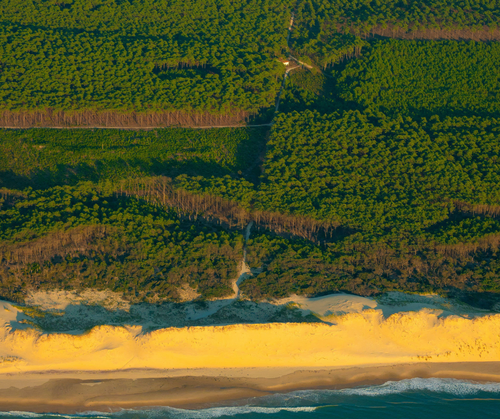
Academics and NGOs recently released new reports about the Europe’s land sink. Against the backdrop of a deadly June heatwave, the science remains as alarming as we have been warned for years. The weakening of environmental policies, and recent upticks in timber harvesting, mean continued extraction of excessive amounts of wood from our degraded forests, driven by vast subsidies for those who burn timber for energy. As Europe heats up, our forestry sector is cruising rapidly in the wrong direction.
We are undermining our forests’ resilience
Shocking news has emerged from a new EU-wide study about the future carbon sink capacity of Europe’s forests. Using country reports from the UN Framework Convention on Climate Change and remote-sensing maps, the EU-27 forest carbon sink is projected to decline by 39% by 2030 under current trends. Forest disturbances (including harvesting) far outpace biomass recovery. Meeting EU forest sink objectives, the analysis indicates, would require substantial changes in forest management; these include lower harvest pressure and stronger adaptation to climate-driven disturbances.
Another new academic study by Professor Gert-Jan Nabuurs and colleagues examining an 18-country consortium of National Forest Inventories (NFIs), provides a high-resolution, tree-level structural analysis of European forests. Contrary to assumptions of old-growth wilderness, this research reveals that more than 90% of Europe’s forests feature structurally simple, even-aged and often single-species compositions. This offers poor resilience to climate-, pest- or disease-related disturbances, and paltry support for biodiversity.
What are countries doing about it?
France offers a disturbing indication, as NGO Canopée’s recently published assessment shows.
A pillar of France’s plan for meeting its climate targets, the Stratégie Nationale Bas-Carbone (SNBC; still accepting comments) fails to make the necessary adjustments to wood procurement practices, to account for the growing mortality in French forests.
Even more stunning: The SNBC suggests increasing the amount of wood extracted from French forests by seven million cubic metres (m3). Without a change, this will significantly harm France’s ability to achieve its climate targets.
A wiser choice for French forests would be to reduce harvesting amounts by just three million m3 of wood, from 53 to 50 million m3. With this adjustment, France would meet its Land Use, Land Use Change and Forestry (LULUCF) targets.
It would require transitions, both from the French Government and from the EU. Above all, dangerous bioenergy subsidies for burning large volumes of timber must be discontinued.
France’s bioenergy subsidy policy has created a self-defeating cycle: By subsidising energy producers to compete for wood feedstocks, the government has inflated industrial-grade roundwood costs by 50% since 2021, pushing their largest pulp mills into bankruptcy. The government’s short-term fix? To increase subsidies to the small part of the business that generates bioenergy – treating a symptom while perpetuating the disease, i.e. escalating subsidies that distort the wood market.
Instead, support could be directed to the forestry sector to re-organise and produce high-quality wood for high added-value applications, and to transition to continuous cover forestry. Many foresters have indicated their willingness, even eagerness, to make such a shift.
The EU urgently needs to reverse the decline in its carbon sink—yet at the same time, it is advancing proposals to weaken the LULUCF Regulation, which is one of the EU’s best tools to address this decline (FW 315). Merging LULUCF targets with other sectors would weaken the signals to transform forestry practices, leaving governments to respond to crises rather than prepare for the future.
The heatwave of June 2026 has made a deadly case for how high the stakes are – for humans, for agriculture and forests, for life. France, and all EU Member States, must phase out bioenergy support, using it instead to encourage diversified wood uses, and get serious about building our forests’ resilience. Reducing the ambition of our climate targets will not help us get there.
Image: Nicolas RUNG/Aero/Alamy
Categorías: News, Forest Watch, European forests