What is the state of European Union forests?
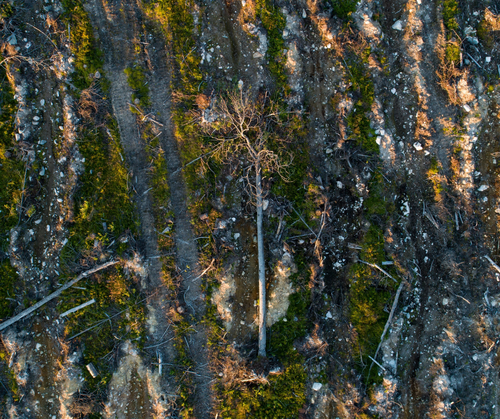
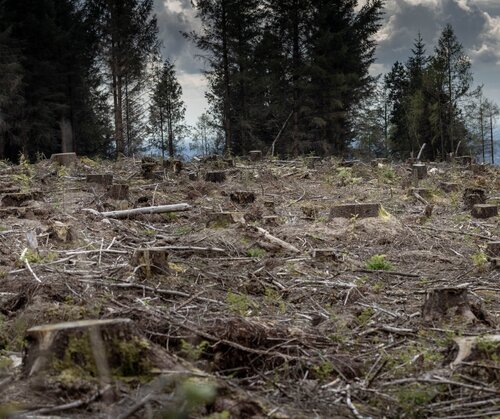
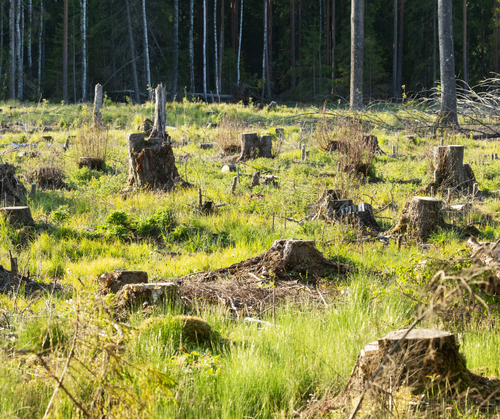
For decades, intensive forestry practices in Europe have meant that healthy biodiverse forests across the EU have been replaced with trees that resemble crops. In 2020, three quarters of forests in Europe were managed through clearcutting, and many of them are in a bad state. Only two per cent of the EU’s primary forests remain, but despite this, not all are protected, and some are threatened with logging.
Intensive forest management not only destroys biodiversity and ecosystems, but also reduces our ability to reach EU and global climate goals. One of the main drivers of such management is that the EU allows Member States to subsidise the burning of forest biomass in the name of bioenergy in Europe.
But it’s not just nature that’s suffering. The extractive forestry industry offers fewer and fewer forestry jobs, undermining sustainable rural development. Intensive logging is also at odds with other less intensive activities, threatening Indigenous Sámi peoples’ livelihoods.
The EU has launched a series of policy initiatives to help it reach climate goals such as the European Green Deal and Fit for 55. These will only work if they put efforts to heal the EU’s degraded forests and improve the lives of those who depend on them at their centre.
Fern's work on this issue
What do Fern and our partners want?
We are calling for an EU forestry policy that protects the remaining old growth forests and restores degraded forest land. This will mean ending biomass subsidies, and enabling foresters in Europe to move away from clearcutting towards close-to-nature forestry.
What are we doing?
We work with foresters, policy makers and NGOs to propose an EU Forest Strategy that will deliver forest management practices that benefit people, nature and the climate.
Can tree planting solve climate change?
Tree planting schemes have always been popular, but never more so than today, where they are frequently promoted as a proposed solution to the climate crisis. There is a long, painful history of bad tree plantation projects, mainly in the Global South but also in the North, where tree planting projects have caused deforestation and social misery, as well as increased climate change. This FAQ explains some of these issues.
What are negative emissions?
Negative Emissions is one of the terms used by climate scientists in the Intergovernmental Panel on Climate Change (IPCC) for activities that remove carbon dioxide from the atmosphere. Other terms include Carbon Dioxide Removal (CDR) and Greenhouse Gas Removal (GGR).
To avoid the climate crisis, the absolute priority is that all sectors of the economy radically and rapidly reduce their greenhouse gas emissions to as close to zero as possible. However, there is scientific consensus that limiting global warming to 1.5 degrees, a globally agreed target, will also require removing carbon dioxide from the atmosphere, hence the need to talk about negative emissions. Scientists are currently debating just how much forests can remove, but we can and must do more to deliver healthy forests in Europe.
What is bioenergy?
Bioenergy is the combination of the terms biomass and energy. Bioenergy is gas or electricity that comes from renewable sources, such as plant matter or animal waste. This is known as biomass. Biomass contains energy stored from the sun. This energy is absorbed during the photosynthesis process. When biomass is burned, its chemical energy is released as heat. Biomass is often burned on a local scale to heat homes and to provide heat for cooking (mainly in less developed countries), and as such is an important part of many peoples’ livelihoods.
However, bioenergy is more often spoken about in terms of the large-scale and intensive harvesting and burning of wood from forests in the US, Canada, and Europe. Today, most biomass which is burnt for energy on this scale comes from trees, and more worryingly, from forests.
This FAQ will explore the links between bioenergy and deforestation, the implementation of bioenergy in Europe and wether bioenergy is renewable or carbon neutral.