Concerns about the termination of the Cameroon-EU Voluntary Partnership Agreement
6 January 2025
The context
Almost half of Cameroon is covered by fast disappearing tropical forests. In 2023, a 12-month Pulitzer Centre investigation confirmed a rise in illegal logging and forest conversion, particularly involving high-value species, and concluded that Cameroon’s state apparatus is often complicit. In 2024, Forest Trend’s Timber Legality Risk Dashboard Cameroon profile stated that from 2001 to 2023, Cameroon lost more than two million hectares (ha) of tree cover (6.5% of cover since 2000). Cameroon’s ports are a central shipping hub for West and Central African forest products, complicating supply chains and origin labelling. Douala port is also a centre for organised crime and illicit exports.
VPA achievements and chronology
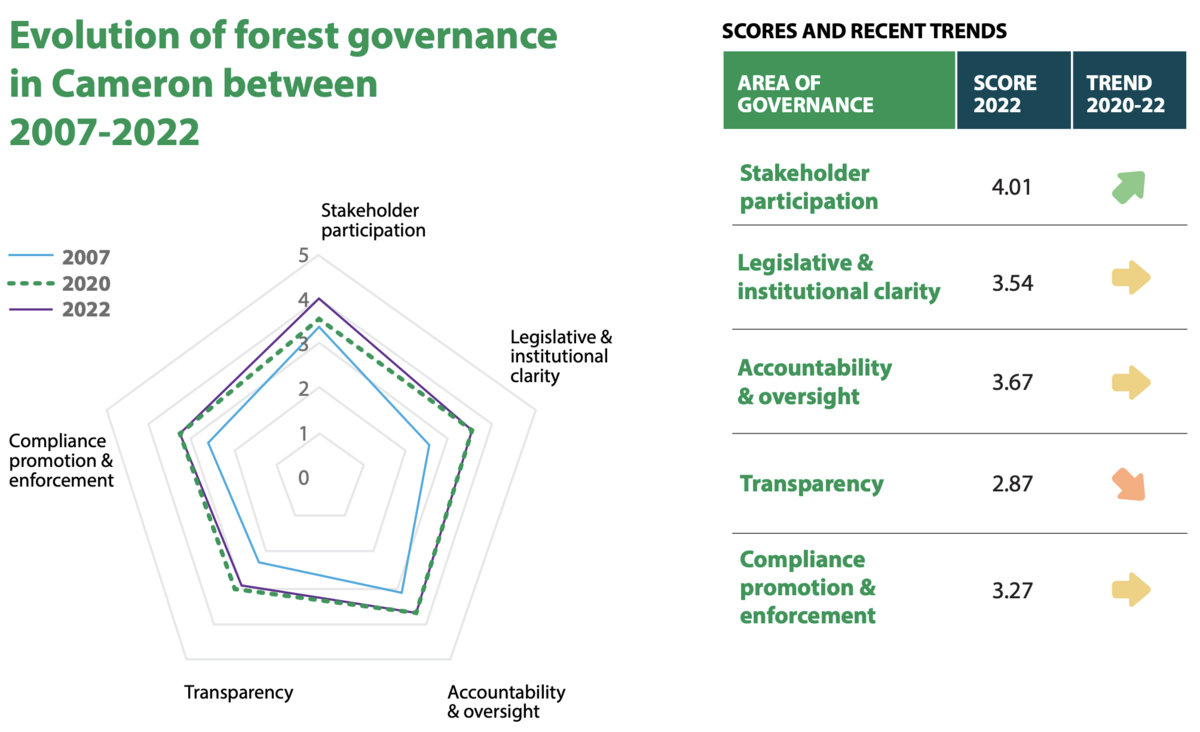
The Cameroon-EU Forest Law Enforcement, Governance and Trade (FLEGT) Voluntary Partnership Agreement (VPA) was signed in 2010 and entered into force in 2011. The European Forest Institute’s (EFI) overview of impacts on forest governance in Cameroon (2007-2022) highlights improvements it achieved in terms of stakeholder participation, access to information, contribution to land-use planning, land allocation, and activities impacting forests and forest lands.
Despite this initial positive momentum, between 2018 and 2023, the Cameroon-EU relationship deteriorated, especially around discussions about Cameroon’s Timber Legality Assurance System (known as SIGIF2). Political dialogue was then reestablished with both Parties agreeing to carry out a joint VPA review in March 2023.
An interim report was released in January 2024 and finalised in July 2024. It presents four scenarios for next steps: three propose to continue the VPA, and one to terminate it “by consensus”.
Although the EU and Cameroon government had not discussed the final report, in August 2024, the Head of the EU delegation met with the Cameroonian Minister of Forests and informally announced the Commission’s decision to “unilaterally” terminate the VPA. On 2 October 2024, they sent a notice to the Council to terminate the agreement “no later than November 30, 2024, so that it will not be renewed automatically.” The notice does not mention the joint review’s recommendations.
The Ministry for Forests and Nature (MINFOF) responded to the notice by publishing the joint assessment, unilaterally.1
It is worth noting that on 2 October the Commission also announced a one-year delay of EU Deforestation Regulation (EUDR) implementation, and published its draft communication on a Strategic Framework for International Cooperation. This draft Framework suggests replacing VPAs with Forest Partnerships, building on their positive elements. The EU Head of Delegation also stated on social media that the EU wishes to conclude a new partnership with Cameroon which would be more inclusive and ambitious as “this may be a more adequate tool in the current context of timber trade”.
Concerns with the EU proposal to terminate
No due process, no partnerships approach: The proposal ignores the joint assessment’s four options. Neither environmental and social NGOs nor the private sector were involved.
Negative impact on EU-Cameroon diplomatic relationship: The Commission claims cancellation would not impact the Cameroon relationship, but when the Minister learned about the EU intentions, he reflected: “MINFOF strongly deplored this decision taken “unilaterally” and in a “surprising” manner by the EU.”
Closing space: The VPA provided a safe space for dialogue between the Government and civil society organisations (CSOs). The EU unilaterally closing down this space is particularly problematic as Cameroonian civic space is rapidly shrinking.
Challenging EU vision on partnerships: Terminating a legally binding agreement with a producer country raises concerns about the EU’s overall vision and strategy on “partnerships.” These concerns are reinforced by the fact that the Strategic Framework for International Cooperation does not focus on bilateral partnerships.
Lack of support for a robust and transformative traceability system: The VPA’s termination raises questions around the EU’s future support for a timber traceability system to help Cameroon meet EUDR timber requirements, which could be built on by other commodities.
Lack of clarity on Forest Partnerships: The Commission appears to see Forest Partnerships as something VPAs should transition into, but little information about them is in the public domain. So far they have not been binding, inclusive, or directly linked to supply chain governance making it hard to see how they can contribute to EUDR implementation.
Conclusion
Although the Cameroon-EU VPA has encountered serious resistance and received less local CSO support than other VPAs, it has also achieved successes that could have been built on.
It is concerning then that it is proposed to be unilaterally cancelled without consideration of the joint assessment. This shows a lack of respect and sets a bad precedent for any future partnership and Members of the European Parliament should therefore insist that no VPAs are cancelled unless both Parties agree, based on a joint assessment of possible implications and a multistakeholder dialogue about possible adequate and effective alternatives.
Categories: Briefing Notes, EU Partnerships, Cameroon