Given political inaction, commercial actors may be choosing to avoid forestry scandals
4 März 2026
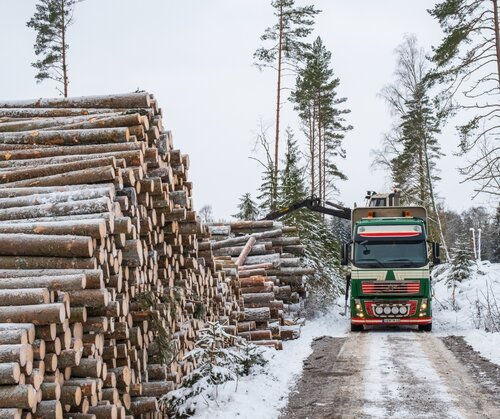
Even though political representatives keep handing forestry lobbyists wins, some commercial mammoths have begun to ignore forestry-sector greenwashing and to distance themselves from Nordic forestry controversial practices.
In October 2025, Nestlé announced that it would no longer source virgin fibre from suppliers involved in controversies in Northern Sweden. Now Zalando, Europe’s leading online fashion and home furnishings platform, has chosen to phase out packaging linked to SCA, the Swedish forestry company.
For years Swedish environmental and Indigenous organisations have levied criticism at SCA for the destruction of Sweden’s natural forests and harm to Saami livelihoods and way of life – pointing out, for instance, 500 of what SCA insisted were ‘single mistakes’ affecting forests with conservation value. In January 2026, civil society organisations hosted a mock funeral for natural forests at Copenhagen’s fashion week, targeting Zalando for purchasing virgin fibre for its packaging from SCA.
Tellingly, after commissioning an independent investigation into SCA’s forestry practices, Zalando has decided enough is enough.
SCA is Sweden’s biggest private landowner, owning 6% of the land. It is also a forestry sector giant, and, through the Swedish Forest Industries Federation, a member of the lobbies for pulp and paper (CEPI), the European organisation of the sawmill industry (EOS), CEI Bois, and Bioenergy Europe. This means that SCA are represented in at least five of the nine lobbies calling to weaken climate targets in the Land Use, Land Use Change and Forestry Regulation (FW 310) as well as other forest-related laws such as the EUDR.
SCA have considerable control over their supply chain – from land ownership, to wood-processing, to production of commodities. As a result, their sourcing, production and employment decisions have impacts across the entire forest sector. But these impacts are not always positive: overall, forestry and wood-based industry employment grew only 1.4% compared to 8.4% for EU employment as a whole (according to 2012-22 Eurostat figures).
More alarmingly, Fern has documented abuse and exploitation of migrant workers in Sweden’s forestry sector. (In this, Sweden is not alone: Finland’s forestry sector is also embroiled in a forced-labour scandal; FW 311.)
But the environmental and social harm that this and other international logging companies cause has not prevented Member States – even the Environment Council – from touting the competitiveness of the traditional pulp and paper sector over environmental protection. Lies and lobbying recently succeeded in killing a proposal to collect accurate, comparable forest data (FW 309); and previously, in gutting the Packaging and Packaging Waste Regulation (FW 283, FW 291). Such lobbying continues to threaten the ambition of EU climate policy and to fuel the rollback of EU environmental laws.
How many Zalandos or Nestlés will it take before SCA wakes up to the idea that major brands no longer want to be associated with SCA’s mismanagement?
Kategorien: News, Forest Watch, European forests, Paper packaging