
A railway through DRC’s Miombo forests: AFREWATCH shares its concerns
1 abril 2026
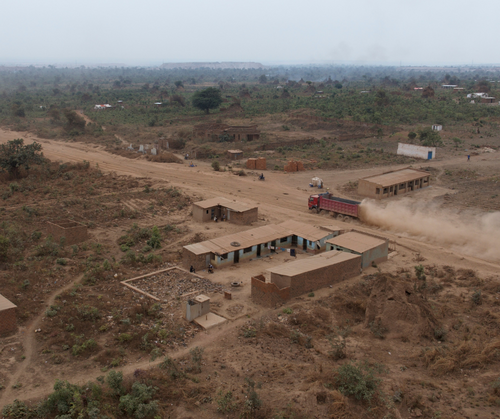
Fern partner AFREWATCH raises concerns about the EU Global Gateway’s massive Lobito Corridor infrastructure project, to which the EU is contributing through the Global Gateway, and the railway section that will cut through the DRC’s sparse Miombo forests.
The global scramble to access critical minerals shows no sign of slowing: China, the US and the EU currently have their eyes on the vast mineral riches of the Democratic Republic of Congo (DRC) and Zambia’s ‘copper-belt’. In October 2023, the EU signed up to the Lobito Corridor project that aims, among other things, to rehabilitate and extend a strategic rail route from Lobito port in Angola to Zambia to extract copper and cobalt from the mineral-rich region.
Couched in terms of sustainability, the clean energy and digital transition, and all-around ‘win-win’, the massive multi-partner project nonetheless cuts through the DRC’s fragile miombo (dry tropical) forests. On 19 March 2026, André Ntumba, head of the Environment and Climate Change programme of African Resources Watch (AFREWATCH), with Fern’s support, presented AFREWATCH’s technical report at a workshop organised in Kinshasa. In front of participants from civil society and four Congolese ministries (Mining; Environment, Sustainable Development and New Climate Economy; Agriculture; and Land), he suggested significant guardrails to frame the project.
The research: AFREWATCH investigated the impacts of previous mineral activities and related infrastructure projects on the unique miombo forests of southeastern DRC’s Upper Katanga region. “We analysed the dynamics of forest cover in the mineral provinces of Lualaba and Upper Katanga, including the Lobito Corridor zone in new research – we wanted to establish a baseline of forest cover against which to measure future impacts, and to assess what protections are needed,” Ntumba explains.
“We were concerned not only with the direct deforestation from mining and associated infrastructure, but also the indirect effects of mineral-related activities on the forests.”
The research covers impacts from 2002 through 2024 when, in response to pressures from the World Bank and the International Monetary Fund, the DRC opened its mineral sector to foreign investors. AFREWATCH carried out an analysis of satellite images and a field mission to back its findings and were able to distil a detailed picture of the largest companies’ deforestation footprint in the area, raising concerns about the Lobito Corridor project.
Findings: “The direct impacts of mining operations included tree-felling for excavations and open-pit mines, but trees are also felled for processing operations, logistical operations, and for roads created to link to asphalted national roads, transport of equipment, and remove processed minerals,” Ntumba says.
They found that miombo forest, which meets the UN ‘forest’ definition, covered some 50% of the Katanga copper-belt in 2000; by 2024 that stood at only 40% – a loss of 873,926 hectares. “To help visualise, that loss is 83 times the size of Paris, France – 3.5 times Paris each year. The impacts are devastating – without even considering associated pollution and contamination of land and waterways”.
The loss of carbon sequestration was no less startling. Using an accepted reference of above-ground carbon stored in miombo forests, AFREWATCH calculated the loss during that period at 108.6 million tonnes of carbon dioxide.
AFREWATCH also drew attention to the vast indirect impacts of the overheated mineral sector. “The region and especially Lubumbashi and Kolwezi have a serious energy deficit, and what electricity is available is used by mining companies. But the construction of roads is drawing in people – in their thousands – who come to look for work, or to start businesses targeting mining workers. They too have an impact. Without access to electricity, they cut-down trees for charcoal, to use for heating and cooking. They also clear trees for vegetable gardens to support their households.
Ntumba continues, “And that entails another devastating impact: the emergence of ‘professional charcoal burners’, operators whose main activity is to go into forest reserves made newly accessible by roads, to cut down trees to make charcoal. These forests are often the ancestral lands of local communities, who depend on them for their livelihoods, giving rise to numerous local disputes and conflicts.”
AFREWATCH and Fern shared their concerns in a briefing note intended for the DRC Government, EU decisionmakers and other investors. The Lobito Corridor project raises pointed questions of EU policy coherence and EU efforts to be climate defenders, even as they help to raze miombo forests to access minerals.
As EU investment in the region scales up, Ntumba discussed the need to halt deforestation and to mitigate mining’s impacts.
“Electrification that is accessible to local populations is an essential first step, as are urgent measures to stop forest loss, which is now accelerating. Forest restoration and replanting should be urgent priorities. Areas zoned for mineral activities must clearly be separated from areas reserved for conservation, and community rights of access and usage rights must be strictly protected.”
Such efforts, he proposed, could be paid for by a deforestation fund supported by the recent EU-DRC Forest Partnership (if this is made more transparent and participative) as well as by the existing deforestation tax that mining companies must pay.
The project is too huge, and the climate stakes too dangerous to allow the EU Global Gateway’s Lobito Corridor investments to serve only private economic interests, inviting destruction along uncomfortable historical lines.
Image: Didier Makal
Categorías: News, Forest Watch, Partner Voices, Critical minerals, The Democratic Republic of Congo