Strategic Minerals and Miombo forests in the Democratic Republic of the Congo
Why the Lobito Corridor will be a test for the credibility of the green transition
EU efforts to secure minerals for the digital and green transition are leading to increased European funding for critical infrastructure projects.
The Lobito Corridor is a case in point.
A 1,300-kilometre railway project linking the Democratic Republic of Congo (DRC) and Zambia to a port in Angola, the Corridor is the African cornerstone of the EU’s Global Gateway initiative, connecting the EU to a region known globally for its rich deposits of cobalt and copper.
It is part of a Strategic Minerals Partnership between the EU, the DRC, and five other parties which aims to modernise infrastructure and accelerate the time it takes to transport minerals to the port – “from 45 days to 45 hours”.
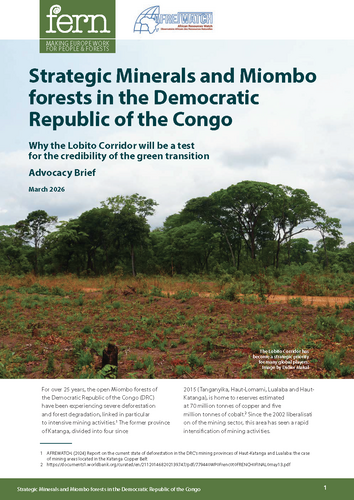
But the minerals are underneath an exceptional forest ecosystem: the Miombo woodlands, the largest dry forest area in the world, covering 2.4 million square kilometres. It is a reservoir of exceptional biodiversity which influences water cycles and temperature patterns, and acts as a sacred space for worship, initiation rites and ancestral cemeteries.
The DRC NGO Afrewatch, supported by Fern, undertook extensive research to show the possible effects of new investments in the Lobito Corrido. We have now joined with them to produce a short report with recommendations for the EU and beyond.
The Lobito Corridor is a real-world test of whether EU-backed investment can reconcile mineral security with forest protection and community rights. So far, the answer is no. Afrewatch and Fern are therefore calling on the EU to:
- Ensure robust environmental and social standards in all EU-supported Lobito Corridor financing
- Integrate zero-deforestation objectives into the EU–DRC strategic partnership
- Support independent monitoring of mining impacts
- Invest in local mineral processing, renewable energy access, and sustainable alternatives to charcoal in the DRC
- Implement ambitious demand-reduction policies (battery size, recycling, modal shift) to reduce overall pressure on critical mineral supply chains
Categories: Critical minerals, The Democratic Republic of Congo