Celebrating the fruits of the EU-Ghana partnership on illegal logging
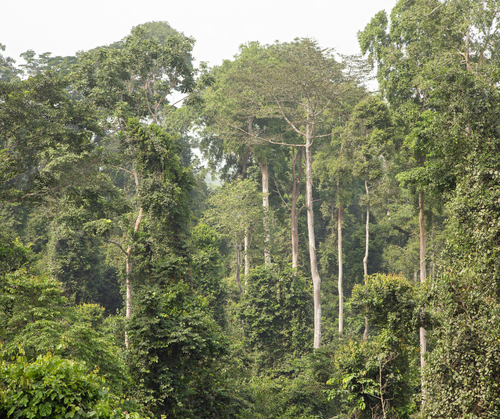
Ghana becomes first African country to issue FLEGT licenses
In a world of environmental, political and financial turbulence, the EU-Ghana partnership on illegal logging offers a powerful example of what meaningful international cooperation can achieve. On 4 November, participants gathered in the European Parliament to celebrate Ghana's historic accomplishment as the first African country—and only the second globally after Indonesia—to issue Forest Law Enforcement, Governance and Trade (FLEGT) licenses for timber exports to the EU market.
The event, co-hosted by MEPs Karin Karlsbro (Renew) and Jean-Marc Germain (S&D) and organised by Fern, brought together a high-level Ghanaian delegation including His Excellency Henry Tachie-Menson, Ghana's Ambassador to the EU, and Martin Oteng-Ababio, Chair of the Board of the Forestry Commission, alongside Marjeta Jager, deputy Director General of DG Intpa from the European Commission, civil society representatives, and industry leaders.

MEPs strike a note of Celebration
MEP Karin Karlsbro, rapporteur in the Parliament for FLEGT since 2019, opened the event by emphasising both joy and the work ahead: "Today, we are here to celebrate and I'm so happy to have all you here but of course in particular our guests from Ghana. The celebration also means we are in the position where we have the privilege to work and follow-up and look at the future."
MEP Jean-Marc Germain contextualised the achievement by comparing it with current European debates: "Nobody can ignore that there are tough debates all over the world about deforestation. Some Member States and some Members of Parliament—many of them, too many of them—and some companies also are asking to delay or weaken the EU Deforestation Regulation [EUDR]."
He emphasised why the event was important: "The first reason to be here today is to celebrate a huge achievement because on 8 October 2025 Ghana became the first African country and only the second in world after Indonesia to start exporting FLEGT licensed timber to the Union. This is a remarkable achievement and a pride for Ghana and all partners who have support this."
Germain also clarified the Parliament's position on FLEGT: "We think that the FLEGT system is the really good one. We are very committed to have the system succeed in the country where it's still implemented. It's one of the key successes of the EUDR because if we want companies to be able to apply the Deforestation Regulation, then we need in the countries exporting wood to have strong systems of tracing wood and other products."
A partnership requiring courage on both sides
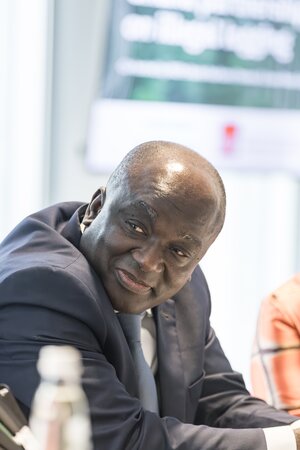
Ambassador Henry Tachie-Menson opened with observations that cut to the heart of what makes the partnership work. "The partnership is very important for us, it signals that Ghana is doing something good, not involved in illegality, and wants to have sustainable forest management."
He emphasised that Ghana's reforms—updating old laws, reforming systems and processes—were undertaken in direct response to EU requirements. "It took us a long time and was very arduous, so the cooperation should continue."
The Ambassador was candid about the multi-stakeholder process: "Civil society when they are around, they give us a lot of headaches, but civil society have been part of this process, so we need to accommodate them, listen to them, and come up with consensus, so it takes time."
Understanding the journey
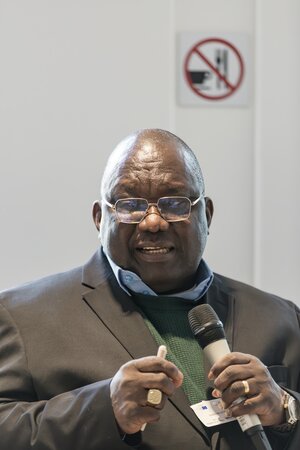
Martin Oteng-Ababio, Chair of the Board of the Forestry Commission, highlighted the crucial role of the EU's own commitment in catalysing transformation: "The EU saw that a lot of people were engaged in illegal lumbering, and having that conviction and decision not to buy illegal lumber actually served as a catalyst to push this agenda. If the EU had continued to buy illegal lumber, the trip would have been difficult."
He emphasised that getting to the root of problems takes time. In a society where approximately 70% of the timber trade operates informally and land ownership is complex, uniform agreement required genuine multi-stakeholder engagement.
He also urged the EU to look beyond timber: "This conversation should move beyond just the FLEGT, you should be looking at green economy in total. Can we look at other green economy to supplement, so that we can diversify the things we do."
EU commitment
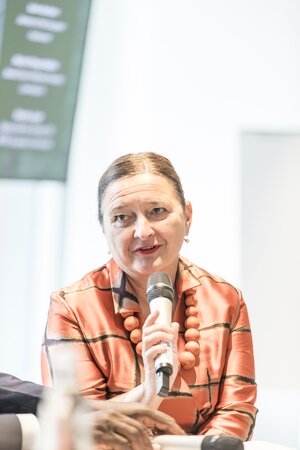
The European Commission's Deputy Director General for International Partnerships, Marjeta Jager congratulated Ghana on behalf of Commissioner Jozef Sikela, noting that "Ghana is now a frontrunner in forestry law enforcement and governance. This is something that you should be very, very proud." She also emphasised that: "This enormous task of legal compliance, law enforcement, change of legislation, stakeholders’ participation —is due to your political commitment."
"The main beneficiary is the planet, because you are one of the very few countries which can show an increase in forest cover. The second is the people, because your people benefited from these efforts. And the third is trade and business facilitation, because it provides the green lane on legality to the EU market."
Crucially, Jager confirmed that because of the Voluntary Partnership Agreement (VPA), Ghana qualifies as the lowest risk category under the EUDR and explained why the EU ended VPAs in Liberia and Cameroon: "The main ingredients is political commitment and the will of the partner countries to basically implement the VPA and to really do everything to get to the FLEGT licenses. We cannot do that for our partner countries."
She was emphatic about continued EU support, where there was political will in partner countries: "We have accompanied our partner countries with all our knowledge, with all our tools, with all our technical assistance that we have in order for it to work. And that's why, again, we are so happy to be here today… Clearly the objective of VPA and the FLEGT is still in the heart of our action in DG INTPA."
More than just licenses
As Fern's Hannah Mowat noted in her closing remarks, "The point of the VPA wasn't just to get the licensing. It was all the things that we achieved along the way.
Those achievements are substantial. Over sixteen years of partnership, Ghana has reformed its forest laws, strengthened institutions, established robust timber traceability systems, and embedded multi-stakeholder participation—including meaningful civil society engagement—into forest governance. The country has also achieved something increasingly rare: an increase in forest cover.”
Benefits for business
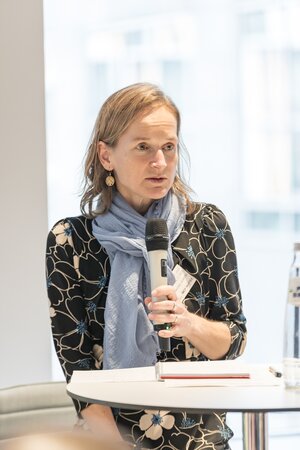
For European timber importers, Ghana's FLEGT licenses provide crucial trade facilitation. Ingrid Hontis, Manager for Sustainability at Fedustria (Belgian federation of woodworking and furniture industry), emphasised that traceability is becoming increasingly critical as multiple EU regulations come into force.
"This FLEGT license system really is a big help for our companies. It's a brilliant way to work together on sustainable trade and sustainably harvested products, and at the same time we can be sure that we protect our forests."
She also shared her experience of visiting Ghana in 2024: "People were very aware about traceability issues. If I asked them about the EUDR, they knew very well what I was talking about. I must say, when I go to a company here in Belgium and I talk about EUDR, often they don't have a clue what it's all about. But in Ghana people were very aware."
Women's leadership in forest governance
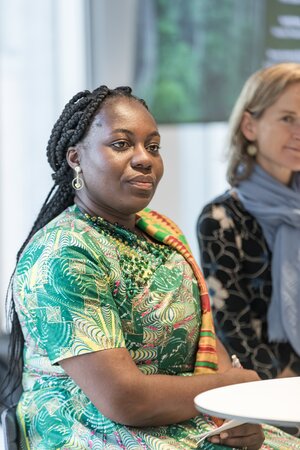
One striking aspect of Ghana's VPA journey has been the advancement of women's participation in forest governance. Doreen Asumang-Yeboah, Executive Director of the Rights and Advocacy Initiatives Network (RAIN), described how the sector has been transformed over the past sixteen years.
"Previously when you talked about forests, people will naturally relate it to males because we're thinking of timber. But the forest is more than timber. Through capacity development and positive action—including prioritising women for board and committee positions—civil society has successfully shifted mindsets.
We made them understand that when we are talking about gender in the space, it's not about pushing the men away to take the space. It's about allowing the women to come on board, play the roles that we can play well to complement what they are doing already. And that message went well with them."
What comes next
While celebrating Ghana's achievement, participants were frank about challenges ahead. Hugh Brown, chief executive of the Forestry Commission stated that FLEGT licences risk being meaningless if only two countries have them, urging the European Commission to continue supporting other countries with national traceability schemes.
Ghana's delegation expressed willingness to share experiences with other countries. As Ambassador Tachie-Menson put it: "Ghana has some lessons to share. The multistakeholder approach is very difficult...but it's an approach that can be used in other countries. We want to see some form of cooperation from the EU, to continue to cooperate with Ghana and to see what we can do to help others."
As one Ghanaian civil society film screened at the event demonstrated, this partnership has delivered tangible results for forests, communities, and trade. The question now is whether the EU will build on this success by supporting more countries to follow Ghana's path.
To find out more about the achievements of the FLEGT VPA process in Ghana read this article by Fred Pearce.
Cover image: Hennadii Filchakov/Shutterstock
Event images by Elza Lőw
Catégories: Events, Illegal logging, Ghana