
Gold mining and deforestation
9 juin 2026
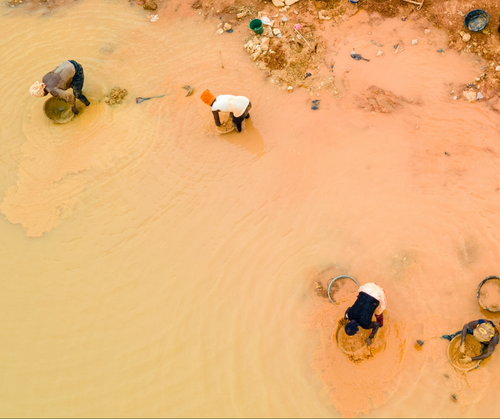
Is gold mining driving deforestation?
Yes, gold mining is driving deforestation. Since 2013, gold has become the leading mineral driver of deforestation, causing 3,520 km² of forest destruction between 2000 and 2019, according to researchers at the University of Vienna.
There is huge concern that with the surging price of gold, forests and peoples will be increasingly threatened. As with other forest-risk commodities, when prices increase, so does forest clearance. Data shows that gold related deforestation spiked in 2012, when prices rose. Recent, close-range satellite data of the Amazon shows that as the price of gold doubled between 2025 and 2026, deforestation levels followed suit.
Which countries have the highest deforestation rates from gold mining?
The forests most impacted by gold mining are in Russia, Brazil, Suriname, Ghana, Peru, Indonesia and Myanmar.
How is gold mining impacting Indigenous Peoples and local communities?
Gold mining impacts Indigenous Peoples and local communities in several ways, including:
- Water and food contamination: Mining using heavy machinery near water bodies pollutes critical drinking sources. This is exacerbated by heavy use of poisonous chemicals such as mercury and cyanide, used to extract very fine gold particles from ore. These chemicals can also enter the food chain. In Ghana, leading doctors have spoken out over the link between lowered fertility, birth deformities and mining-related (Galamsey) food and water poisoning.
- Violence and territorial dispossession: In the Amazon, local organisations report violent clashes between Indigenous Peoples and illegal miners, who seek to protect their territories and way of life.
- Direct health impacts from industrial mining: In 2026, an investigation by the Associated Press into the impact of a major mine in Liberia, Bea Mountain, whose sole buyer is Swiss refinery MKS Pamp, found evidence of poisoned fish that were consumed by local communities and led to serious health problems, and possibly fatal impacts on the local communities. The campaign to bring justice for these communities is still ongoing.
Despite these serious risks, artisanal and small-scale gold mining (ASM) — much of which operates outside formal legal frameworks — remains a critical source of income for many communities. It is essential to support processes of formalisation and support national governments to tackle the systemic poverty driving small-scale miners into gold mining.
What should forested countries do to reduce impact of gold mining on forests and peoples?
To reduce the impact of gold mining on forests, it is crucial that governments in forested countries tighten regulatory frameworks, and ensure that mining, forestry and environmental regimes operate in a coordinated way to reduce inconsistencies, address regulatory gaps and ensure enforcement. Some countries, such as Ghana, are moving in the right direction: in 2025, Ghana’s government announced it would ban mining in forest reserves. A platform of civil society organisations working on gold have issued a roadmap of priorities.
What can European countries do to address gold-related deforestation?
Since most gold is exported, both through official and unofficial routes, purchasing countries have a high responsibility. These include key European countries such as the UK, the world’s largest over-the-counter gold market, and Switzerland, which refines 60% of the world’s gold.
A global coalition of civil society organisations working on environmental crime and corruption, including Fern, has developed a roadmap to address the acute problems mining and the trade of illicit gold creates. Recommendations include:
- Create binding multilateral agreements between priority countries to address illegal gold-mining’s root causes, develop national traceability systems, identify legal and law enforcement gaps, and tackle the systemic poverty driving small-scale miners into illegal supply chains.
- Treat illegal gold exports as a money-laundering predicate offence so as to ensure such laws can be activated to address the trade in illegal gold.
- Increase oversight of the financial sector as many European countries have large and growing gold reserves, meaning gold is directly placed in central bank reserves.
Image: AeroVision Gh/Shutterstock
Catégories: FAQs, Critical minerals