
Green Development Advocates: Update from Cameroon
16 septembre 2026
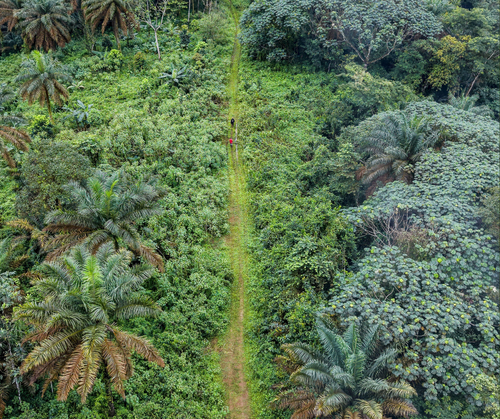
Green Development Advocates’ (GDA) political analyst Alain Mfoulou offers insights into the present state of Cameroonian forests and EU efforts to support them.
In recent years, Fern’s Cameroonian partner GDA, has supported the Baka peoples against the looting of natural resources in the Djoko Community Forest and the Ngoyla Wildlife Reserve, where they hold customary rights thanks to the Asbabuk-Minfof Memorandum of Understanding. As this agreement was intended to compensate for conservation-driven restrictions to other Baka territories; these fresh betrayals are more painful, with both areas now threatened by extractive activities.
Ngoyla Wildlife Reserve and the Djoko Community Forest: In 2022, Decree no. 2022/395 (17 August) was quietly delivered to the Cameroon Mining Company – without Free, Prior and Informed Consent of the Baka peoples affected, without official declassification of the Reserve’s protected status, without undertaking a current impact study (there is a long-expired study from 2010, but the law requires a certificate of conformity with a study no more than three years old).
The mining permit covers 768.5 km2 – 25.67% of the Ngoyla wildlife reserve. Shockingly, it also swallows the entirety of the Baka peoples’ Djoko Community Forest of roughly 5,000 hectares; the community forest had been created specifically to protect the Baka peoples’ cultural and spiritual identity. The permit specifies that the company had five years to begin operations, prior to which the state would clear the timber to prevent it being ‘lost’.
From November 2024, GDA and other Civil Society Organisations (CSOs) repeatedly contacted the Ministry of Forests and Fauna (MINFOF) for answers. Until recently, silence was the only response.
In November 2025, satellite alerts from Global Forest Watch (GFW) began coming in, signalling deforestation in the protected area and the Djoko Community Forest attributed to a Baka community of of Se’eh et Assoumindele 2, whose population of women, men and youths, numbers around 200. By early June 2026 there had been 42,566 alerts in the Ngoyla Reserve and 2,347 in the Djoko Community Forest.
In May 2026, GDA cooperated with local independent forest monitors to go on site and ‘ground-truth’ the satellite alerts, confirming the widespread destruction of the forest cover.
The local communities have since reported forestry activities in these zones. Neither consulted nor consenting, the Baka people’s access to their sources of food, subsistence agriculture and natural remedies is being harmed, as is their access to their sacred sites and cultural spaces. Wildlife habitat and corridors are being destroyed, and poaching is on the rise.
An NGO communiqué (1 July 2026) denouncing the “timber looting” of the Reserve and community forest under the “specious pretext of implementing the Mbalam iron project”, addressed a series of recommendations to authorities, forestry and mining companies, and technical and financial partners. It generated considerable interest and provoked a response from the previously mute authorities.
MINFOF organised a working meeting (10 July 2026) with Indigenous Peoples and Local Community (IP&LC) representatives and CSOs, during which it swept aside allegations of procedural violations and “silent pillaging”. MINFOF made the startling assertion that, as it was signed by Cameroon’s President, the Decree issuing the mining permit constituted sufficient ‘declassification’ of the Reserve and Community Forest’s protected status.
Alain Mfoulou points out, “Nowhere in law does such a ‘de facto’ declassification exist, and GDA itself participated in ground-truthing missions subsequent to these alerts. We are currently preparing a report that clearly lays out legal and factual arguments.” Meanwhile, the forests of Ngoyla and Djoko, and Baka ancestral sites, are falling to chainsaws, despite mining laws prohibiting mining within 500 metres.
Subregional Forum: How Can We Slow the Conversion of Forests? Forest conversion, destruction timber and other resource extraction, agriculture and mining are by no means uncommon. Sadly, across the Congo Basin, CSOs and IP&LCs are embroiled in similar situations, yet responses remain fragmented.
GDA therefore convened a Forum in Yaoundé, 18-19 August 2026, that hoped to overcome the tendency to approach persistent problems ‘in silos’.
From across Cameroon, Gabon, Republic of Congo, Democratic Republic of Congo, and the Central African Republic more than 100 public, private, academic and CSO representatives met to pool experiences and lessons learned. They explored strategies around forest conversion and its evolution in the Congo Basin; opportunities for common action; regional forest policy coherence; technical tools to ensure accountability for conversion; and financial mechanisms to support forest preservation.
Emphasis was placed on support from EU partners, through Voluntary Partnership Agreements, Forest Partnerships and the EU Deforestation Regulation. Concerns were raised regarding the lack of the EU’s continued financial and diplomatic commitment to improving forest governance, the expansion of ECOFAC (Central Africa) to NaturAfrica (all of Africa) without a significant increase in resources, and the impact that the new Global Gateway approach – which prioritises the private sector – might have on forests. The Forum also specifically recommended the creation of a sub-regional observatory to track forest conversion across the Congo Basin.
Above all, the importance of protecting Indigenous Peoples rights was noted. With the exception of the Republic of Congo, which long ago adopted a specific law on Indigenous Peoples, their status is almost never enshrined in the region’s legal texts, leaving them inadequately protected. Participants identified COMIFAC’s (Commission des Forêts d’Afrique Centrale) Convergence Plan for the Conservation and Sustainable Management of Forest Ecosystems in Central Africa, currently being revised, as a positive foundational text into which their rights should be inserted.
Catégories: News, Forest Watch, Partner Voices, EU Partnerships, Cameroon