EVs and critical minerals: Adjusting early could serve commercial and public interests
8 maio 2025
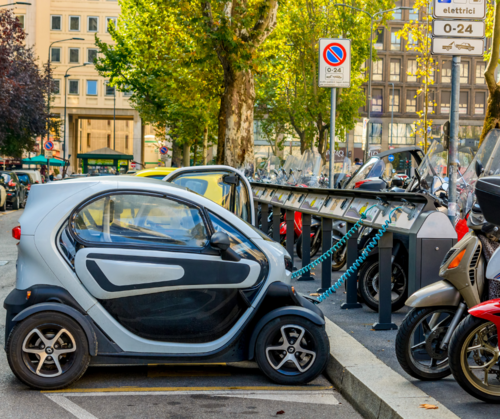
For the first time, new research models the potential deforestation that EU demand for electric vehicles (EVs) could cause through to 2050.
The findings are startling: on current trajectories, EU hunger for the minerals EVs require, which typically lie under forests, will cause the destruction of 118,000 hectares – the equivalent of 18 football pitches of forest destroyed daily for the next 25 years. Our climate cannot afford such devastation; neither can the world’s millions of forest-dependent individuals.
Fern and Rainforest Foundation Norway (RFN) commissioned research from French think tank négaWatt to model the transport sector’s demand for metals and minerals (the iron, bauxite, copper, manganese, nickel and cobalt needed for EV batteries and car bodies); and with the Vienna University of Economics and Business (WU Vienna) to develop different scenarios showing deforestation linked to mining to meet EU demand for EVs.
The resulting study, Driving change, not deforestation: How Europe could mitigate the negative impacts of its transport transition, indicates that, if allowed to continue on its current path, the EU’s scramble to secure minerals will result in unsustainable forest destruction and human rights violations. Such destruction is already underway. Fern’s partners in Indonesia, for example, consider that mining nickel for EVs is overtaking even the ravages of oil palm plantations, and we have often drawn attention to the personal stories of people witnessing their communities and livelihoods ripped apart by mining interests (FW 290) and by political unwillingness to prioritise responsible use (FW 294).
It does not have to be so. The report details another, ‘CLEVER’ scenario that, with two main adjustments, drops projected deforestation by 82%, from 118,000 down to 21,300 hectares.
The first is the adoption of less harmful battery technology, now responsible for 70% of deforestation linked to EVs: this harm could be mitigated by switching to LFP batteries, which use iron and phosphate, rather than the more common NMC 811 that rely on the nickel and cobalt that is linked to higher deforestation. Improved mobility and transportation measures would further decrease the need for critical minerals. The other crucial shift involves avoiding deforestation hotspots such as Brazil and Indonesia when sourcing materials, as forest loss per tonne of metal mined can vary by a factor of 20.
Importantly, such adjustments would also considerably decrease distressing human conflict and legal disputes, as well as the costly contractual delays associated with both, that mining companies frequently underestimate.
Changing course early tends to be easier and cheaper than a massive sea change once investments and attitudes are locked in. This report indicates that an urgent shift is both possible and necessary. Fern and RFN therefore took its message to the 2025 OECD Forum on Responsible Mineral Supply Chains, 5-7 May.
Our session, EU Electric Vehicle targets: Assessing human rights implications, deforestation risks and industry readiness, presented the paper’s findings to participating NGOs, investors and businesses. In addition it featured a representative of Indonesian partner Satya Bumi who works with communities coping with the devastation that mining leaves in its wake, and Edson Krenak (Vienna University), an Indigenous activist and PhD student from Brazil, and an activist fighting nickel mining on Kabaena island, Indonesia; all offered perspectives from affected communities’ lived experiences.
Our worsening global climate requires us to protect a main ally against climate change, forests; our common humanity requires us to avoid harm to the communities that live in or near forests. Despite the fraught political period we are in (FW 304), this report and our partners underscore that commercial interests and the public interest can be reconciled. By adjusting quickly, we could avoid costly, drawn-out legal disputes and leave a survivable world for future generations.
Image: Dizfoto/Shutterstock
Categorias: News, Forest Watch, Critical minerals