Car Sharing is Caring
18 septembre 2026
The path to ending the damage our car culture is causing the planet is clear.
Thousands of towns and cities in dozens of countries across Europe are currently taking part in European Mobility Week: an annual series of events supported by the European Commission promoting “sustainable urban mobility”.
As part of it, the usual traffic clogging Brussels’ roads will be absent this Sunday (20 September) as Brussels celebrates ‘car-free day’, when only certain vehicles will be allowed on the road, and the maximum speed limit is reduced to 30 kilometres an hour everywhere.
This year the messages driving the campaign have even greater urgency because of the ongoing war in Iran.
Six months after the US and Israel launched their assault, its terrible impact is still being felt in the region and across the world: the head of the International Energy Agency (IEA) said the war had led to the “greatest global energy challenge in history.”
In Europe, fuel prices have soared, with governments scrambling to respond.
But there is a way to liberate ourselves from being so beholden to others’ actions - by taking Europeans’ energy security out of the hands of unstable, autocratic regimes.
The Commission’s promotion of “clean transport solutions” at Mobility Week is an important first step, but achieving them, requires deep, systemic policy shifts.
Ending our dependence on private cars
Transport – especially road vehicles – accounts for almost a third of the EU’s emissions.
Passenger cars represent around 70% of transport activity, and numbers continue to grow. Decarbonising our transport by switching from carbon dioxide (CO2) spewing vehicles to less polluting electric ones, is essential, but with cars on the road for 15-20 years, even ambitious policies will take decades to fully electrify the fleet.
And EVs are not a problem-free solution. Ending the stranglehold fossil fuels have over our lives and economies makes no sense if we replace them with other complications – and EVs come at a well-documented cost.
Mining for the critical raw materials - such as copper, lithium, cobalt, bauxite and nickel - needed to make cars and power EVs is trashing precious ecosystems and displacing communities.
On current trends, European EV manufacturers’ demand for minerals will destroy the equivalent of 18 football pitches of forests every day for the next 25 years in irreplaceable diverse forests in Brazil, Democratic Republic of Congo, Indonesia and more. An estimated 69% of current transition mineral projects are located on or near Indigenous or local communities’ lands in the Global South.
Switching to less mineral-reliant battery technologies and building smaller and more affordable cars can avert this damage but alone will not be sufficient: we also need to change our mobility patterns.
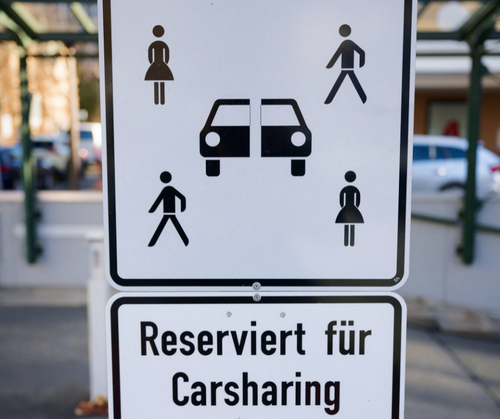
Carsharing should be part of that solution.
A growing body of evidence shows the immense benefits of ending our structural dependence on private cars.
In Belgium, for instance, it was found that thanks to car sharing, 6 out of 10 users have given up their cars, especially for round trips and among city dwellers.
Good for the planet, good for your wallet
Car sharers tend to own fewer vehicles and travel more sustainably than the population in general, combining it with public transport, walking and cycling more often than private car owners (although less in peri-urban and rural areas where public transport can be limited). A shared car in Flanders saves an estimated 13 tonnes of CO2 emissions per year. And research published by Bundesverband Carsharing (the German carsharing association) calculated that one carsharing vehicle can replace 19 private cars, and that there are financial benefits too.
Rather than replacing public transport, walking and cycling, car sharing often complements them, making it easier for households to reduce or entirely abandon private car ownership while maintaining access to a vehicle when necessary. But infrastructure needs to be available to encourage such modal shift.
Concrete policy steps
Decarbonising our transport and reducing our demand for raw materials – including by reducing our dependence on cars through shared mobility - requires structural changes, underpinned by policy choices.
First, we need an EU-wide methodology to precisely define car sharing, and a methodology to calculate its effect. The Netherlands government is working on a definition, and Bundesverband Carsharing has developed a broadly applicable definition. Then there are a raft of concrete measures that can remove political obstacles and create more favourable conditions for shared mobility: supporting charging infrastructure at public carsharing stations, introducing carsharing mobility stations into new areas, and investing in public transport, cycling infrastructure, and pedestrian-friendly urban design.
Another future is possible
These are likely to be popular measures: in May an Ipsos poll found that across the globe, 66% support cycling lanes, and 73% support pedestrian priority in school zones. They also found a generational shift, with “younger respondents […] less likely to view car ownership as essential and more open to multimodal lifestyles.”
Incentives such as vouchers for new customers; a taxation system taking into account the distance and the occupancy rate of vehicles; a zero or lower VAT rate for shared cars; public investment and subsidies to level the field with subsidies given to private EVs; and legally requiring employers to offer employees a mobility budget instead of a company car.
The equation is simple: the less we depend on cars, the better for the climate, the forests, biodiversity and people bearing the brunt of the damage caused by the surge in mining for critical raw materials.
Image: IMAGO/Rolf Poss / Alamy
Catégories: News, Critical minerals