
News
Frequently Asked Questions on Biochar
Introduction
For a forests and rights organisation such as Fern, biochar is important because it often comes from wood, and there are more and more projects to produce it at a large scale across the world. Many forest communities and organisations are being approached by biochar project developers and need to know how to respond. While biochar has until now been mostly used for agricultural applications, it is increasingly developed for producing carbon credits to be sold on voluntary carbon markets, and EU policymakers are currently considering including it in the EU’s carbon market (the EU ETS) as a carbon removal option.
Many considerations on this page are technical, but here are simpler observations:
- In agriculture, the most discussed possibility, using biochar as a soil amendment can be beneficial in specific circumstances and not in others—so biochar use needs to be tailored to the local context. The right type of biochar must be used for a given soil, because biochar application to soils is irreversible and can also involve significant risks for human and soil health, fertility and food safety. This also means that whenever biochar is used as a soil amendment on farmland, it is absolutely essential that farming, long-term soil health and food safety remain the dominant priorities. Not the production of carbon credits.
- While biochar use in agriculture has already been researched a lot, there is still a need to produce independent knowledge that is detailed enough to provide guidance to policy-makers and farmers on how to reliably reduce risks and ensure benefits. That knowledge is currently being built by scientists and researchers all over the world but remains insufficient. Its production must be supported.
- The most suitable feedstock for longer-lasting biochar seems to be wood. Biochar is a form of charcoal: all the issues associated with charcoal (e.g. air pollution, deforestation and forest degradation, unfair North-South trade regime, environmental and human health damages) can also be found with biochar.
- Beware climate claims. The side-products of biochar production, representing at least 50% of the original biomass’ carbon content, are typically burnt or directly released: in the short to medium term, in most cases, biochar production and use increase greenhouse gas emissions compared to a situation where biochar would not have been produced. Climate benefits can be obtained in the medium to long-term depending on feedstocks, production methods and non-production scenarios.
- Including carbon credits from biochar in a large compliance carbon market such as the EU ETS would undermine the ability of the ETS to reduce emissions because it would enable offsetting. It would also create excessive incentives for using biochar and in a way that is disconnected from farming, risking to drive considerable additional wood demand and damage to forests, the climate, and soils. While EU regulation of the toxicity and safety aspects of biochar production and use is already quite developed, the recently adopted EU CRCF sustainability safeguards and criteria for biochar credits certification remain insufficient to ensure climate benefits because they are based on political compromises, not science.
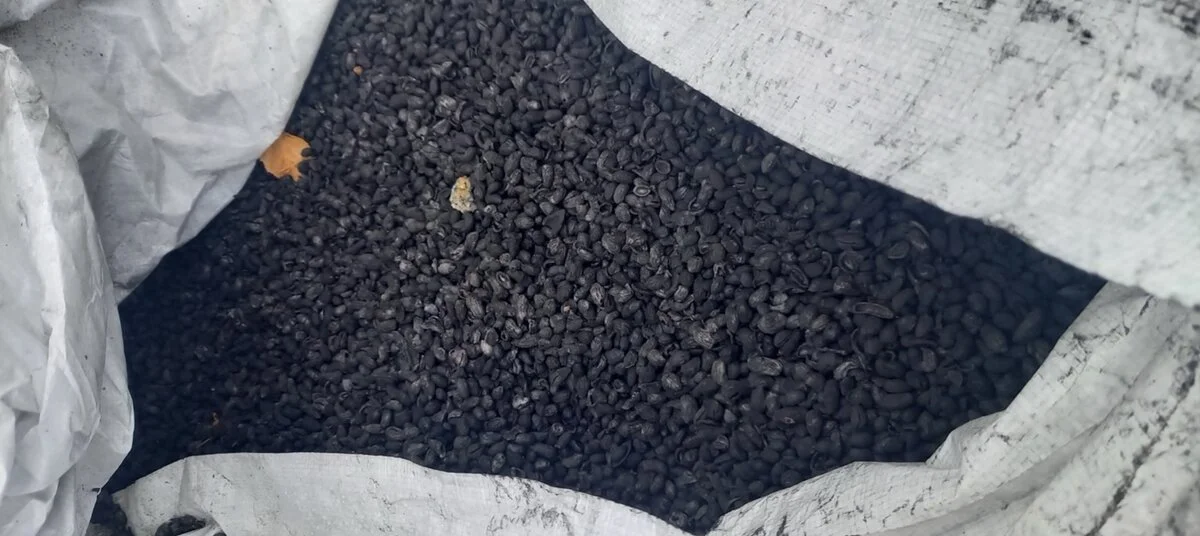
A bag of biochar made from olive pits in Finland. Fern visit to biochar start-up Carbo Culture, August 2026
What are biocharcoals, also known as biocoal, green coal or “biochar”?
“Biochar” is a recent term, probably coined around 2005, to describe charred biomass, a form of charcoal. Charcoal is primarily made by pyrolysis: organic material (most often wood) is heated in a minimum-oxygen environment that prevents it from burning or combusting.
This breaks molecules into simpler gases, liquids and solids, and the resulting solid is very rich in black carbon which resists natural decomposition much better than the original biomass. Bio-oil and syngas are side products, in proportions increasing with temperatures (up to 85-90% in highest temperatures), and are usually either burnt for energy production or released, emitting CO2: biochar production is also often a form of bioenergy.
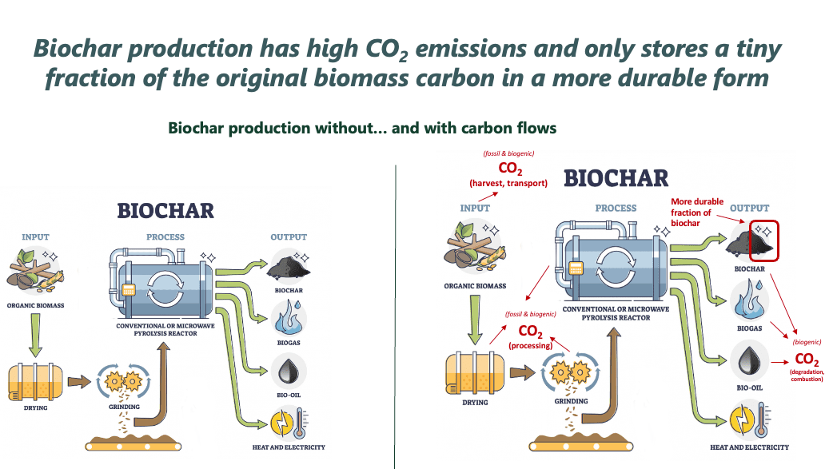
Source: Fern adaptation from a common biochar production infographic
It also creates ashes and residues, depending on the biomass type and pyrolysis used. The higher the production temperature, the higher the carbon concentration and ash content in the end result. Ashes can contain both nutrients and pollutants.
While charcoal has historically been produced as a fuel and made from wood, biochar can also be made from crop residues, organic waste, manure, and other biomass sources. The result usually appears in the form of pellets, granules or powders. Wood appears to be the most suitable feedstock for the production of biochar, with the highest levels of carbon classified as long-lasting. The production process determines the suitability of the product to various uses: what performs for energy might not deliver as a fertiliser or animal feed.
The type of biomass used (e.g. soft or hard), the temperature, conditions and duration of the pyrolysis all affect its chemical properties: like biomass, “biochar” is not a standardised product but covers a wide diversity of materials, whose properties depend on how and where they are produced and used. Biochar is typically composed of various carbon compounds of varying durability, from rapidly dissolved to longer-lasting ones.
Biochar is more or less porous and offers a spectacularly high surface area at the microscopic scale. It can therefore create a good habitat for soil microorganisms, help retain water, and enables substances to bind to it through adsorption (the same characteristic as with “activated charcoal” used in water filtration, which has a higher carbon content).
How is the European biochar market structured?
According to industry sources, global biochar production is growing rapidly and reached an estimated 520,810 metric tonnes (mt) in 2025, up from 180,150 mt in 2023. Asia is the largest production region, followed by North and South America. Agriculture remains the dominant use, but non-agriculture uses such as building materials are also growing.
In Europe, finding public reliable sources on how much biochar is produced and what it is used for is difficult. Most of the biochar (about 75%) is supposed to be used as a livestock feed additive, where, according to a recent independent scientific literature review, it "enhances livestock performance by increasing nutrient digestibility, growth performance as well as nitrogen retention" (although adverse effects have also been documented in dairy cows as it can bind critical micronutrients, and the broader problem of variability of biochar types makes comparison and universal dosing guidelines difficult).
Most of the rest, about 25%, is used as a soil amendment, a growing market. It is also used as a tree planting substrate, with for instance the city of Stockholm mixing it with soil when planting new trees.
According to the biochar industry lobby group Biochar Europe, there would also be “immense market potential’’ for using “biochar” in metallurgy as a replacement for fossil coal (one of the largest charcoal production facilities in Europe was built for that purpose in 2023 by ArcelorMittal in Belgium), but this consists in practice in burning charcoal in blast-furnaces; the method is not new (it has been used in Brazil for decades) and the climate benefits are doubtful.
Is biochar good for farmland?
Incorporating biochar into agricultural soils requires tillage. It is irreversible. There is therefore a need for caution and rigorous information on the materials, processes and properties of the biochar used, in order to protect future soil health and fertility.
Biochar is rarely applied on its own, because doing so would deplete the surrounding soil from water and nutrients and it does not itself include all the nutrients that plants need. It is rather mixed with synthetic or organic fertilising materials, manure, slurry or anaerobic digestate before application, a means to speed up the process that increases soil fertility. It has been used on most crops, from cereals to oilseeds and tubers, and, when used well, can replace synthetic fertilisers that cause significant climate and soil damage, water pollution, and food supply contamination. Ongoing research projects examine using biochar in forests too.
As pointed out previously, it is difficult to generalise conclusions about a product with such a high level of heterogeneity. Using biochar as a soil amendment has been researched a lot, and the independent scientific literature points to a wide range of possible effects, from beneficial to harmful, reflecting the variety of feedstocks used, pyrolysis methods employed, and soils to which it has been applied.
In general, positive case studies tend to come from poor, acidic soils, in particular in tropical ecosystems where soil organic carbon levels are low, but the picture is much less clear in temperate climates and richer soils (some reviews actually do not find positive effects on average in temperate latitudes). According to recent scientific literature reviews (such as Bhattacharyya & Sandilya (2024), Antonangelo (2025), Bekchanova (2024)), the main positive effects, possible benefits, negative effects and risks of biochar application on soils identified are the following (keeping in mind that all these effects depend on the types of biochar and the types of soils):
| Positive effects & possible benefits | Negative effects & risks |
|---|---|
|
|
In the European context, an obvious drawback to biochar use in the Mediterranean region is that its water retention properties in some soils can make it attractive, but its high pH risks undermining soil fertility by increasing alkalinity in the region’s already alkaline soils if the biochar is not mixed with other materials that reduce its pH.
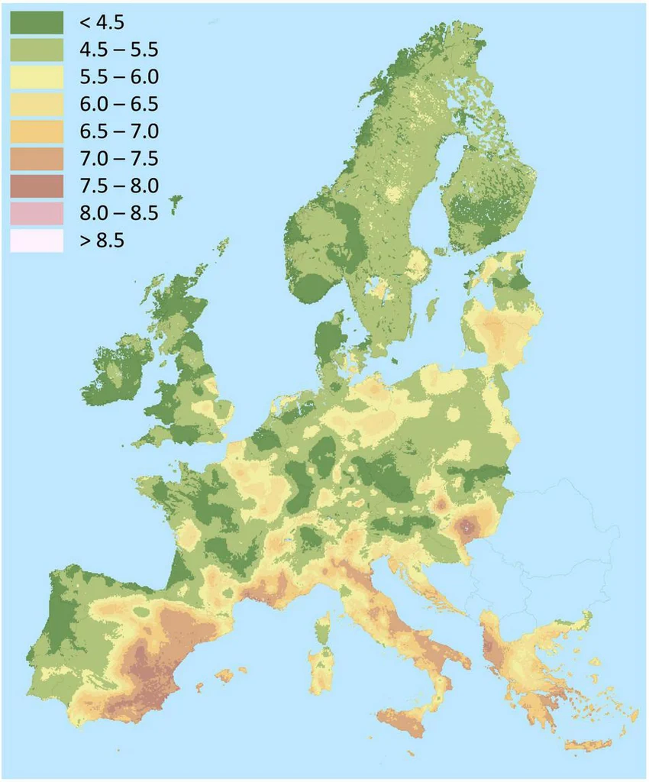
Map of soil pH in Europe. Source: Land Resources Management Unit, Institute for Environment and Sustainability, European Soil Data Centre (ESDAC), esdac.jrc.ec.europa.eu, European Commission, Joint Research Centre (Panagos et al., 2012).
This necessity to tailor biochar use in farming to the local context is evident from the literature.
For instance, a 2025 scientific review of studies from across the globe found that average benefits from long-term biochar applications included “improved crop yields (+10.8%), reductions in CH4 (–13.5%) and N2O (–21.4%) emissions, and increased soil organic carbon content (+52.5%). In contrast, these benefits tend to diminish over time with single biochar applications due to the aging effect of biochar. Results from 29 global long-term experiments (4 to 12 y) confirm these sustained benefits for crop yield and greenhouse gas mitigation, although the magnitude of effects varies with soil properties, climate, and management practices.”
Yet, in Switzerland, federal authorities recommended caution in March 2026 due to mixed experiences and remaining knowledge gaps: “no evidence has been found to suggest that the use of biochar in Swiss agriculture leads to increased yields. Long-term effects on soil and soil organisms are still unclear and may be irreversible. Biomass is a valuable raw material, and there is competition for its use. The potential of biochar to mitigate climate change is limited, and its use is generally not economically viable. Widespread use is not recommended until any possible harmful effects can be ruled out.”
This points to an important conclusion: there is still much independent research needed to create knowledge that is detailed enough for policy-makers and farmers to identify when the use of biochar, and which biochar, is beneficial or not to specific soils and ecosystems.
Is biochar the same as "terra preta"?
No. While this is an argument sometimes used by biochar proponents to associate biochar with the famously fertile “terra preta” of the Amazonian basin, anthropologists have shown that this “dark earth”, the result of intentional soil enrichment practices by Indigenous people, is the outcome of more complex processes than just biochar application to soils.
How toxic can biochar be to soils and the environment?
Biochar’s toxicity depends on how it is made and what it is made with. A 2021 scientific literature review by Xiang et al concludes that “biochar poses potential environmental risks to soil, water, and atmosphere owing to its harmful components, adverse surface properties or structure, and chemical characteristics at micro-/nano-dimensions. The wider application of biochar has potential environmental uncertainties” and that “considering the harmful components, structure and particle size of biochar, the negative effects of biochar application on the environment should not be ignored.”
As well as tending to increase soils’ alkalinity, biochar can indeed contain problematic levels of toxic contaminants such as Polycyclic Aromatised HydroCarbons (PAHs), dioxins, furans or heavy metals. These contaminants can come from contaminated feedstock, especially heavy metals, but not only: they can also result from the pyrolysis process itself, especially when low temperatures are used – but these low temperatures produce much larger volumes of biochar, a perverse incentive for producers. Higher temperatures, in turn, increase the concentration of heavy metals in the biochar produced, which could become a problem if the original feedstock contained too much. A comprehensive review of the challenges to safely produce and use biochar was compiled by Dong & al in 2025.
How much air pollution can biochar production and soil applications cause?
Pyrolysis for biochar production is a process that releases pollutants in the air. These include:
- Particulate matter (PM)
- Smoke
- Fine dust
- Volatile organic compounds (VOCs)
- Polycyclic aromatic hydrocarbons (PAHs)
- Nitrogen oxides (NOx)
- Carbon monoxide (CO)
- Sulphur compounds
To mitigate this risk, filters and other pollution control devices need to be applied to protect workers and neighbouring communities. When these systems are insufficient or dysfunctional, air pollution is caused. Recorded cases of such air pollution have been recorded in Denmark, the United States, Nigeria, among other countries.
Another risk to air quality is the release of dust from biochar application on soils. Inhaling fine biochar particles during handling presents respiratory risks. The degradation of biochar at the nano scale also raises safety questions that still need to be researched.
In addition, because biochar is a form of black carbon, such dust release increases total atmospheric black carbon, a residue of incomplete biomass combustion that is not only toxic for humans but also a major short-lived climate forcer, second only to CO2 in driving global warming. With a warming impact 460–1,500 times stronger than CO2 per unit of mass, it creates rapid warming in the atmosphere and accelerates melting when deposited on snow and ice (leading to reduced albedo effect). Industry sources describe various methods (such as maintaining high moisture content) to limit the release of air pollutants and dust during applications.
How are the toxicity and safety aspects of biochar production and application to soils regulated in the EU?
Because both its production and applications involve environmental and health risks, strict regulations on biochar production and applications are indispensable.
General EU regulation of biochar as a substance of concern
In the EU, biochar is currently regulated within the charcoals category under EU chemicals regulation, REACH (Registration, Evaluation, Authorisation, and Restriction of Chemicals): producers, importers, distributors and users handling more than one ton of biochar per year have to register their activity, a process that includes testing the presence of the main pollutants (metals, PAHs, PCBs etc). The European Chemicals Agency (ECHA) is currently examining broadening the charcoal dossier to biochar.
Air pollution
Biochar production facilities in Europe are typically small to medium size. As a result, their emissions of pollutants into the air fall under the scope of the EU Medium Combustion Plant Directive, for installations in the 1 to 50 MW capacity range (installations smaller than 1 MW are covered by the Ecodesign Regulation, and those larger than 50 MW by the Industrial Emissions Directive). This Directive sets emission limits values for sulphur dioxide (SO₂), nitrogen oxides (NOx), and dust/particulate matter. Local air quality regulations will also apply, depending on local authorities’ action to comply with the EU Air Quality Directive.
Soil pollution
In 2021, the EU included biochar in the list of Component Material Category products 14 (Pyrolysis and gasification materials) under the EU Fertilising Products Regulation. Under this regulation, feedstocks for biochar production are restricted to unpolluted organic matter, non-chemically modified processing residues from the food, pulp, paper, bioethanol, biodiesel, and separately collected bio-waste. Materials from mixed municipal waste, sludge and animal by-products (with exceptions) are excluded.
In terms of contaminants in the end product, the Regulation sets maximum limits for biochar applied to agricultural and forest soils.
The EU February 2026 Delegated Act on permanent carbon removals, which defines the methodology for certifying carbon credits from biochar projects, uses the same maximum limits, but sets additional ones for biochar used as a feed additive (in which case some values are lower) or incorporated in products (such as asphalt or concrete).
The European Biochar Certificate, an industry certification scheme, has aligned its standards on these values.
A scientific study shows, however, that while these standards reduced a lot the levels of the worst contaminants in the biochar used, they remained insufficient to prevent toxic effects on certain plants in experimental conditions. Another study (from 2018) found that even biochars then compliant with EBC PAH limits could still transfer PAHs into edible vegetables at high application rates, and suggested treating biochar to remove PAHs before soil applications.
Does biochar remove carbon dioxide from the atmosphere?
Biochar production does not by itself remove carbon dioxide (CO2) from the atmosphere. On the contrary, while it transforms some biomass carbon into a more durable form, the rest is emitted to the atmosphere when the co-produced bio-oils and syngas are burnt for energy, or straight into the air when no energy is produced. In the short to medium term, like with any bioenergy activity, biochar production therefore increases biogenic CO2 emissions compared to a non-production scenario. In the medium to long term there is more potential for climate benefits, but this depends on the biomass feedstock, the production and application methods, and the non-production scenario considered.
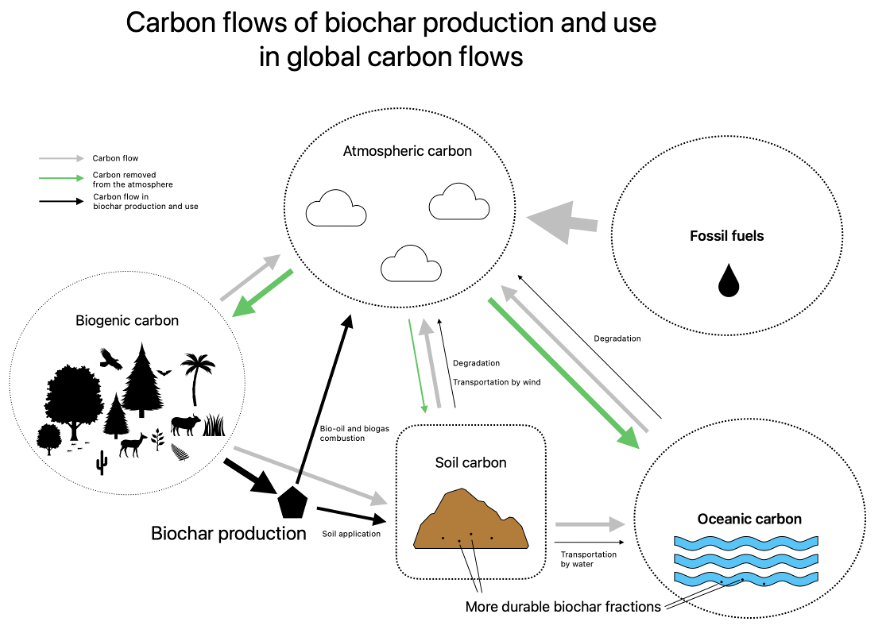
The main climate argument in favour of biochar is that a share of the carbon it stores can be kept out of the atmosphere for longer than if it had remained in the original biomass or in the soil. Over time, therefore, a climate benefit can, it is claimed, be generated by plant regrowth, assuming it grows back by at least as much as what was used to produce the biochar.
The proportion of biomass carbon turned into “durable carbon” varies depending on processes, in particular temperature: the higher the temperature used for the pyrolysis, the higher the “durable” proportion of carbon in the resulting biochar, but the lower the mass of this biochar, and the higher the mass of bio-oil and syngas produced. The maximum experimental proportion of supposedly durable carbon one can obtain from pyrolysing dry wood into biochar appears to be in the range of 40-50% of the carbon originally present in the wood. It is likely that rates achieved in industrial scale operations are lower.
The biochar industry’s main hope for growth is climate policies: by portraying biochar application to soils or incorporation into products as a type of carbon removal from the atmosphere, they can sell carbon offsets. This is already the case on voluntary carbon markets, where biochar production generates the vast majority of carbon offset credits, and why the industry is lobbying to have carbon credits from biochar projects included in the EU Emissions Trading System (EU ETS).
Stories of carbon compensation
As with all offsets, claiming biochar delivers climate benefits requires companies to sell a story about what would have happened in the absence of the biochar project.
While it is not possible for anyone to say what would have happened for sure, one of the likely things that could have happened in the absence of biochar production incentives is that plants harvested for biochar would have continued growing and sequestering CO2 from the atmosphere until their death, or, in the case of harvesting or processing residues, that those would have decomposed over time or be used for something else. How long these plants would have kept growing, or how fast these residues would have decomposed, is an essential parameter.
Carbon debt: feedstocks and the land carbon sink
Forests can store carbon for hundreds and sometimes even thousands of years, meaning that if whole trees from forests are used for biochar production (a worst-case scenario), atmospheric CO2 levels are increased (and carbon sequestration is reduced) by as many years. This difference between the two scenarios is called the carbon debt. In our post-1.5°C world, where all emissions, fossil and biogenic, need to be reduced as fast as possible, this carbon debt obviously needs to be as small as possible.
Using logging residues or dedicated crops with a faster rotation, such as annual plants, can create a smaller direct carbon debt, but diverting finite land to biochar production also adds to the overall pressure on land use and can cause indirect deforestation (a form of Indirect Land Use Change, ILUC). This phenomenon is the reason the EU is trying to phase out incentives for biofuels made from high ILUC crops such as palm oil or soy. To evaluate the possible carbon benefits of a biochar project, one needs to also consider the state of the land carbon sink in the country the biomass feedstock used comes from.
A model developed by scientists in 2018 shows that, because of their initial high emissions, biochar projects using logging residues (in Oregon, USA) increase emissions for several decades before starting to generate climate benefits compared to a scenario where these residues are left to decay on site (Oregon has a cold climate, meaning logging residues decay slowly). The model is very sensitive to the conversion efficiency, in other words the efficiency of the system to convert biomass carbon into durable biochar: the lower the proportion of durable biochar produced, the more carbon is lost to the atmosphere and the longer the carbon debt becomes, turning decades into centuries before climate damage is evened out and climate benefits can start being generated.
Real residues are in scarce supply
There are better climate arguments for turning true residues into biochar. Those residues are the byproducts of the logging and processing of plants cut for another reason (timber, fibre or food production). Like the bioenergy industry, most biochar project developers insist that they only use residues, but such residues are limited in reality: there is already a strong competition between various industries and sectors for the use of biomass and biomass residues, and wood-using industries are already facing a supply crunch in Europe. This crunch is being exacerbated by the EU subsidising the use of wood as an energy source, which NGOs including Fern are calling to be phased out.
This limited supply of residues, combined with EU bioenergy subsidies, creates a strong bottleneck to the deployment of biochar production in Europe, and a powerful incentive for biochar project developers to both define residues in the broadest possible sense and to call for policy support to better compete with the subsidised bioenergy sector. A more logical step would be to end bioenergy subsidies. See Fern’s bioenergy campaign for more information, in particular the misleading use of the “residue” category, which includes all trees whose commercial value is not higher as something other than fuel.
A specific and open question of growing relevance is the use of invasive plant species as a feedstock, as this can help controlling an environmental hazard, provided the harvesting and transport themselves do not help propagating these plants. A study was for example done in Spain using two invasive acacia species in a protected area. A recent case in Gujarat, India, where this was the argument used to justify developing large biochar production in a very poor region, has however probably caused more harm than good (the invasive species was not removed but farmed, and working conditions and air pollution were terrible).
How permanent are biochar carbon removals?
Scientists recommend that “in the context of the Paris Agreement, at least centennial timescales should be considered” for “durable or long-term CDR” (carbon dioxide removal). Can black carbon from biochar be expected to last that long without degrading such that the carbon it contains returns to the atmosphere?
The permanence of biochar is difficult to predict because of the large variability (and current lack of traceability) in feedstocks used, the differences in how it is produced, and the contexts in which it is applied.
Once incorporated in soils, biochar is broken down in small particles by erosion (from wind, ploughing, water) and biological activity (such as animals, fungi and bacteria), and some of the carbon from this erosion is degraded and eventually returns to the biogenic carbon cycle. But the different fractions of biochar are not degraded at the same pace: while the more easily degradable fractions are decomposed faster, the harder ones are degraded much more slowly in soils. How slowly? The problem is that most of the degradation research is done in laboratory experiments that do not reflect natural degradation conditions, and biochar promoters compare it with geological carbon that is not exposed to comparable degradation conditions.
The EU’s climate scientific advisers observed in 2025 that “further research is needed for biochar to demonstrate the ability to securely store CO2 permanently without human intervention”. While biochar promoters insist that the most recalcitrant fraction of biochar (the so-called inertinite fraction) degrades so slowly that it should be considered as stable as fossil coal and permanent, a recent independent long-term in situ study in Spain found that nearly half the modelled biochar was missing and that the main models and methods used to predict and measure how much biochar was likely to remain in the soils after 10 years were not sufficiently reliable (notably because biochar in soils quickly becomes a fine particle and is easily displaced by water, wind or animals such as earthworms). Some German scientists argue that biochar cannot be equated with inertinite in fossil coal, because inertinite was protected for millions of years by burial and inclusion in minerals under high pressure and temperatures while industrial biochar is a different material. The EU's CRCF methodology for assessing biochar's permanence (see dedicated section) proposes testing the proportion of inertinite in the biochar as one of the two ways to quantify permanent carbon removals credits.
An assumption made by many biochar researchers is that even when displaced, this fraction of biochar resists degradation and can end up in rivers, lakes and sediments on the bottom of the oceans. But research has shown that black carbon dissolved in seawater is degraded by sunlight and oxygen, and that “the photo-lability of components of the dissolved black carbon pool increased with their degree of aromatic condensation”, high aromatic condensation being precisely a characteristic of biochar’s inertinite fraction. As a result, the study found, “the apparent survival of dissolved black carbon molecules in the oceans for millennia appears to be facilitated not by their inherent inertness but by the rate at which they are cycled through the surface ocean's photic zone”.
More research therefore needs to happen to better understand the global black carbon cycle, and to what extent, how fast and in which proportions the particles of inertinite biochar can remain undegraded in the long term despite their vulnerability to sunlight and oxygen when turned to dissolved black carbon in water.
If incorporated into waterproof long-lasting products such as asphalt or concrete, rather than soil, biochar is likely to last undegraded at least a few decades. Similarly, if stored in unused coal mines, it will not be subject to wind or water erosion and to only little biological activity, although it would then be accessible to those wanting to use it as fuel.
While the EU Carbon Removals and Carbon Farming Regulation (CRCF) ended up listing biochar as a possible permanent carbon removal pathway (see below), this is at least partly the result of lobbying by the biochar industry: when biochar was first discussed in the Commission’s expert group on carbon removals (Fern is a member), it was referred to as an option for “carbon storage in long-lasting products” – not as a permanent carbon removal option. Biochar was not included in the European Commission’s proposal to include permanent carbon removals in the EU carbon market, the EU ETS. The Commission Impact Assessment (p.65) for the revision of the ETS Directive recognizes that for biochar, the main uncertainty is the degradation rate of the stored carbon over time. The document continues by admitting that there is a shortage of studies confirming its permanence. This assessment supports the Commission’s choice to exclude biochar from ETS integration.
Can biochar production lead to deforestation and carbon release?
Charcoal production has been a deforestation, forest degradation and air pollution driver for centuries, both in Europe and abroad. If left unchecked or insufficiently regulated, biochar production could also have comparable consequences. Large biochar projects currently being developed in tropical countries risk producing biochar that causes deforestation and forest degradation.
In the EU, such risks have been limited in the CRCF methodology for the certification of carbon credits from biochar projects, which mandates that both the production and use of biochar happens in the EU, and that only wastes and residues as defined by the EU’s Renewable Energy Directive are used as feedstocks -- although this is insufficient (see “residues” section).
In EU countries such as Estonia, Finland or Germany, managed forests have been over-logged and/or degraded due to climate impacts. As a result, carbon emissions from forestry operations there are higher than what forests can remove from the atmosphere: these countries have lost their land carbon sink. Additional logging pressure created by more wood demand coming from biochar incentives would entrench or worsen the situation.
Since wood charcoal is explicitly listed in Annex I of the EU Deforestation Regulation (EUDR), and biochar is regulated as charcoal in the EU (at least under the REACH Regulation), biochar from wood will be regulated when the EUDR enters into application, in January 2027.
Does the EU CRCF certification methodology work to ensure biochar is climate positive?
No. Carbon Removals and Carbon Farming (CRCF) methodologies for “permanent” biomass-based carbon removals (biochar and Bio-Carbon Capture and Storage – BECCS/BioCCS) do not ensure climate benefits for at least three reasons:
- They are a political compromise based on a legal fiction: the zero-rating of biogenic carbon emissions in the EU’s carbon market, the EU ETS. These emissions are supposed to be implicitly counted already in the land sector, but only when the biomass fuels used comply with the EU Renewable Energy Directive's sustainability criteria for biomass: the principle has no consistency. In the case of biochar, this means that all the CO2 emitted during the combustion of bio-oil and biogas, and the subsequent degradation of biochar itself, is counted as zero for compliant biomass.
- The EU's own climate scientific advisers said explicitly, in their dedicated CDR report (p.137), that EU rules for BioCCS/BECCS should not rely on the Renewable Energy Directive's (RED) sustainability criteria for biomass because these had failed to protect the land carbon sink. The same argument applies to biochar. Yet the European Commission did exactly that: biomass feedstocks used for biochar must comply with these criteria as evidence of sustainable sourcing, and their restriction to waste and residues as defined by the RED is insufficient because these categories are too broad (see “residues” section).
- By counting a permanent carbon removal at the point of injection (for BECCS) or application (for biochar), the CRCF certification methodologies assume that transferring carbon from the biological to the geological and soil carbon pools is a removal from the atmosphere. This is simply not true: BioCCS/BECCS and biochar reduce bioenergy emissions, but do not in themselves remove carbon from the atmosphere – this is achieved by plant growth. And by counting biogenic carbon emissions as zero (see above), they omit the existence of the carbon debt created by the biochar and the increased climate damages this causes in the short and medium term, whereas the climate crisis has never been so dire and all carbon emissions, fossil and biogenic, must be reduced as fast as possible.
In addition, CRCF rules do not require monitoring of the permanence of biochar, only that it has been applied to the soil, under the assumption that the carbon stored in the durable fraction of the biochar remains stable over a long enough time. Neither do these rules mandate field tests or soil sampling. While correctly monitoring biochar’s fate in soils is a challenge, this was an opportunity to generate the data that is precisely missing to better understand which biochar to use in which agricultural context; but it has been missed.
As a result, the CRCF rules for generating permanent carbon removal credits with biochar are not aligned with the best available science and do not respect the CRCF’s legal mandate – in other words they cannot demonstrate that the carbon removals are real, quantifiable, and permanent. Environmental NGOs (including Fern) have requested that the Commission review these methodologies and that they do not use them to create incentives for the production and use of biochar.
Biochar soil applications and their impacts on soil emissions: the priming effect
A significant impact of biochar application on soil emissions can be the priming effect: the change in the mineralisation rate of native soil organic matter following the addition of biochar. Immediately after application (often within the first few weeks to months), biochar frequently increases CO₂ emissions from native soil because the easily degradable fraction of biochar stimulates microbial growth and co-metabolism. This effect slows down once labile fractions of biochar are depleted, and in the long run these losses tend to be less than the long-lasting carbon added by the biochar itself.
However, a 2026 meta-analysis found that biochar-amended soils were likely to emit much more CO2 under the influence of global warming and called for the inclusion of such warming effects into biochar applications and life-cycle assessments.
Contact us
-

Martin Pigeon
Martin Pigeon
Martin is an experienced researcher and campaigner who documents the damage that EU bioenergy policies cause to forests, human health, the climate and the economy. He aims to redirect policy towards encouraging wiser wood uses for forests and the people depending on them (all of us!). His background is in exposing corporate power and lobbying in EU policy-making, in particular in the land sector (water and agriculture) and the strategic use of expertise (regulatory toxicology and research policies).
- Languages: English, French