A lever for justice
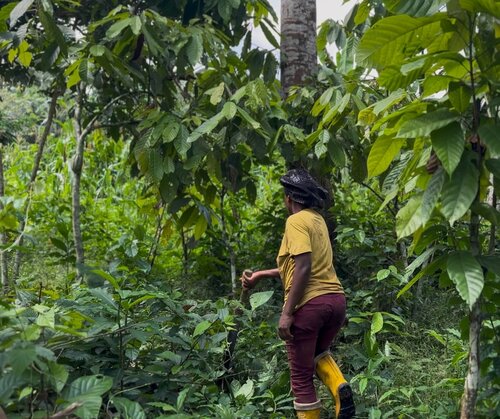
As cocoa prices surge, two new studies reveal that the new frontiers of cocoa production in Central Africa are seeing women’s rights trampled and rising deforestation. Tyala Ifwanga argues that the EU’s much delayed anti-deforestation law can help end these harms.
The damage cocoa production causes in Cȏte d’Ivoire and Ghana, the world’s biggest producers of the commodity, is well-documented.
Rampant deforestation, child labour and the poverty scarring the lives of many smallholder cocoa farmers, have become synonymous with those countries’ industry.
Now, as cocoa prices reach record highs and chocolate companies’ profits soar, production is surging across Central Africa: in the Democratic Republic of Congo (DRC), the Republic of Congo (RoC) and Cameroon. What’s more, the problems blighting the trade in West Africa are spreading like a contagion.
Yet, outside of Cȏte d’Ivoire and Ghana, they are largely under-reported. Two new reports help rectify this.
As well as documenting some of the environmental and social costs of cocoa production in the Republic of Congo and Cameroon respectively, the reports highlight the urgent need to apply a law which can help stop the damage: the EU Deforestation Regulation (EUDR), which aims to ensure that specific commodities aren’t linked to recently cleared forests.
Unfortunately, the EUDR has been under attack for the past two years, and at the end of 2025 was postponed by the European Parliament for a second time.
Slash-and-burn farming
The first report is by Brazzaville-based NGO, Forum pour la Gouvernance et les Droits de l’Homme (FGDH), which works with forest communities in Congo.
It shows how the revival of Congo’s cocoa industry is being driven by high cocoa prices on the international market, with Europe the main export destination. It also notes that the smallholder farmers who are expanding their plantations lack information to produce cocoa properly.
In the Sangha department, the heavily forested area in the north of the country, researchers found the widespread use of destructive slash-and-burn farming methods, in which land is clear cut and remaining vegetation burned. Not only is cocoa production driving deforestation and degradation in the area, but the cocoa plants themselves are increasingly prone to disease and death, as they require shade, which the large clear-cut trees had provided.
The report shows how cocoa cultivation has proliferated in Congo over the past five years, with 33% of registered plantations created after 2020. This is particularly relevant in the context of the EUDR, as to be exported to the EU, the seven commodities (including cocoa) that the law targets, must not have been produced on land that has been deforested or degraded after 2020.
When the law is finally applied, it could provide the impetus for smallholders to adopt more sustainable farming practices. Specifically, they could be supported to maximise yields on their own plantations before expanding and clearing new land. At present land is often clear cut as a way of claiming ownership, even if it isn’t then cultivated. If they were informed that cocoa produced on new land won’t be sold, they would be less likely to expand.
The FGDH researchers also found that women and Indigenous Peoples were victims of discrimination in the sector, specifically through their limited access to land.
Women sidelined
The essential yet precarious role of women in Cameroon’s cocoa industry is the focus of the second study, published by the Centre for Environment and Development (CED) Cameroon and Fern.
Cameroon is the world’s fourth largest cocoa exporter, and the study shines a light on the invisibility of women's work in the sector, and the violence associated with it. It shows that Cameroon’s cocoa sector would collapse without women, while finding that 87% of women cocoa producers among those surveyed experience land insecurity, with a “significant asymmetry in income management”.
“Even when women do most of the work, they control only a fraction of the money received from cocoa—often 20% to 30% (used for household expenses). Investment decisions, wealth accumulation, and participation in cooperatives remain largely the preserve of men,” it says.
It also highlights the increased vulnerability of Indigenous women (particularly the Baka), who are doubly marginalised, and, according to the study: “at the bottom of the social and economic hierarchy. They often work on third-party plantations, with little or no control over their income and significant exposure to violence and discrimination.”
As with the cocoa sector in Congo, the EUDR could help address these problems and be a lever for social justice.
For this to happen though, its implementation must have targeted measures, including securing women’s land rights, access to information and training. Women's agricultural entrepreneurship must be supported, including their participation in cooperatives and governance bodies.
As the world’s largest importer of cocoa beans and a significant trade hub for cocoa and chocolate products, European policymakers and companies – like their Cameroonian and Congolese counterparts – must use their power to end the environmental and social harm caused by cocoa’s production.
Ensuring that the EUDR is properly implemented would be a major step in the right direction.
Categories: News, Forest Watch, EU Regulation on deforestation-free products, Cameroon, Cote d’Ivoire, Ghana, The Republic of Congo