
Bonn Climate Talks and Roadmaps: Address flawed definition and accounting mistakes, or fail
Reija Mikkola, Policy and Campaigns Coordinator for the Biomass Action Network of the Environmental Paper Network International, spoke with Fern about the forest and climate consequences of critical issues that must be urgently corrected, lest COP31 be doomed to failure.
The UN Framework Convention on Climate Change (UNFCCC)’s mid-year technical meetings offer a calmer space in which to refine and resolve scientific details of climate policy. That is the theory, at least: this year’s Bonn Climate Meetings (SB64), 8-18 June 2026, left several essential issues unsettled – including adaptation finance and the just transition. With regards to forests and bioenergy, the Biomass Action Network (BAN) argue that much of what is wrong is rooted in the intensive forestry industry’s overbearing role in creating underlying definitions, and their lobbying for convenient rules. A first, crucial step is to stop letting the wolf guard the sheep.
“SB64 was intended to tackle research and science advice in negotiations that are more technical to advance key topics from COP30, and to bring issues forward to prepare COP31,” Mikkola says. But the BAN team, divided across different subjects and meetings at SB64, found over and over that national positions were entrenched and unyielding. “Countries blocked progress, and were unwilling to commit to any binding initiatives, arguing that everything should be left to national authorities to decide.”
COP30, under Brazil’s presidency, reached no solution on forests or the transition away from fossil fuels, so Brazil is preparing two roadmaps on each of those topics. Based on submissions from countries, civil society and UN entities, they will prepare a report with recommendations for each roadmap in the lead-up to COP31.
“At SB64, Brazil hosted side-events and presented analysis on both roadmaps, and BAN noticed serious flaws and misconceptions that remain in both and have become part of the discussion. We are very concerned: If these issues aren’t fixed, if bioenergy is included in either, both roadmaps will fail.”
Roadmap for Halting and Reversing Deforestation and Forest Degradation by 2030
A huge, initial problem is that the Forest Roadmap does not define forest degradation properly.
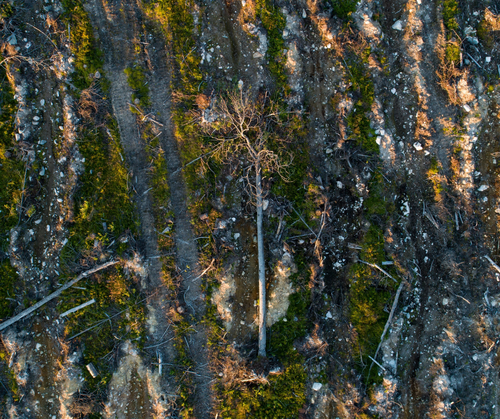
‘Sustainable Forest Management’ is proposed as a climate mitigation solution when, for example, the Nordic-style is anything but sustainable: this forestry model is based on intensive, industrialised forestry. Somehow, this is not seen as problematic. Even the clear-cutting that dominates Nordic forestry is not considered ‘deforestation’.
How did anyone come to so illogical a conclusion?
“Deforestation is defined only as permanent land-use change. Nordic forestry interests – my country, Finland, included – argue aggressively that clearcutting does not result in ‘permanent’ landscape changes because the trees are replanted. That natural forests are replanted with monocultures, that their biodiversity is thus destroyed, that the carbon store is lost – none of that is taken into account,” Mikkola says.
“If not considered deforestation, clearcutting should at the very least be considered forest degradation, and it should be properly defined in the Forest Roadmap to address its extremely harmful implications. Forests are not just cubic metres of wood, trees per hectare – they are living ecosystems that have a height dimension, diverse compositions. Higher biodiversity means higher carbon stock, and much greater resilience to natural stresses. “Once felled, a natural forest is gone for decades or centuries – in biodiversity terms, one could say forever. Many species – for example a lichen – cannot get on their feet and relocate.”
“Another misconception driven by the forest industry concerns carbon accounting for forests, namely confusing sinks with storage. The industry often claims that only young forests are good carbon sinks. This ignores the immense carbon storage that old-growth forests contain, and research shows that old forests do in fact keep absorbing carbon.”
These outdated views, driven by biomass and pulp and paper industries, allow over-harvesting and clearcutting to slip past carbon-accounting definitions; but they are currently a leading cause of the collapse of Europe’s carbon sinks.
Roadmap for Transitioning Away from Fossil Fuels in a Just, Orderly and Equitable Manner
The Transition Away from Fossil Fuels Roadmap also risks reproducing carbon-accounting loopholes that incentivise the use of biomass. These are flaws that scientists have flagged, with concern, to the Intergovernmental Panel on Climate Change (IPCC)—and until they are fixed, they will continue to plague future efforts to contain runaway climate change. Again, these rules fail to consider forests as complex ecosystems: they are based on the assumption that forests will regrow, and carbon will be re-absorbed.
When woody biomass is burned, the carbon emitted from the actual burning – i.e., the ‘smokestack carbon’ – simply vanishes from accounting methods. But it is added to our atmosphere. The initial intention was to avoid double accounting, but the result is that smokestack emissions are unaccounted for.
The implicit assumption is that these emissions will be reabsorbed in the land use sector. However, the temporal element is ignored: regrowth will take decades and more for forests. The problem is compounded on a generational scale and impacts other aspects of carbon accounting.
“Allowing these problems to continue means that the biomass industry continues to be subsidised and to expand, despite its failure to reduce emissions. In fact, it increases them: per unit of energy produced, biomass emissions are actually higher than coal!”
Also, there is a risk of treating ‘bioenergy’ as mainly liquid biofuels. These are problematic in their own right, but a deeper problem is the failure to acknowledge that a significant amount of ‘bioenergy’ is woody biomass – i.e., burning whole logs for energy – again releasing carbon to the atmosphere.
Finally, the technological ‘solutions’ that the Roadmap risks endorsing, Carbon Capture and Storage (CCS) and Bioenergy with CCS (BECCS), are a dangerous gamble: “No working facilities exist for these. They are still being developed, and so are completely unproven at scale. And yet RSPB research shows that 83% of countries’ Nationally Determined Contributions (to emissions reductions) include these in some way. Only six propose BECCS concretely, but for these six, it would take land more than twice the size of Germany to put their plans into practice.”
Where do we go from here?
Emissions continue to rise, and the climate emergency is accelerating – as heat-related deaths globally, and across Europe in June 2026, illustrate.
Stopping false solutions being perpetuated is a crucial, obvious first step. Definitions of deforestation and forest degradation must stop discounting the clearcutting of entire forests; accounting rules must stop discounting vast categories of actual emissions. A next step is to ask difficult questions about who is benefitting from these falsehoods, while ordinary people, communities and ecosystems pay the costs.
“Bioenergy, including biomass, must be excluded from international climate targets, or they will fail. Mis-consideration of bioenergy as a ‘renewable’ leads to subsidies, and the whole approach is wrong: we destroy our forests and don’t meet emission reductions. These policy failures then result in a fail for climate, a fail for biodiversity, and a fail for local communities.”
For more on this issue, please see the Biomass Action Network blog.
Image: adamikarl/Shutterstock
Categories: News, Forest Watch, Partner Voices, European forests