CRCF: will the European Commission reward clear-cutting forests with carbon credits?
On 11 June 2026, just days after the earliest heatwave ever recorded in Western Europe, the Commission’s Expert Group under the Carbon Removal and Carbon Farming Regulation (CRCF) will discuss “challenges and perspectives” around the development of a certification methodology for forest management, with a view to present the methodology next year.
After 25 years of scandals and intractable over-crediting in carbon offsets markets, the CRCF’s purpose is to boost trust by building an EU-approved carbon removal credits market with dedicated certification methodologies. So far, methodologies have not inspired confidence.
Certified stories, uncertain outcomes
The Commission has already adopted questionable certification methodologies for Direct Air Capture (DAC), Biogenic emissions Capture with Carbon Storage (BioCCS) and biochar (charcoal incorporation in soils or long-lasting materials). It will soon adopt two more: “carbon farming” and tree planting. Civil society and scientists’ verdict has been consistent: these methodologies cannot withstand scrutiny.
Methodologies for DAC, BioCCS and biochar, supposed to deliver ‘permanent removals’ of CO2 from the atmosphere, cannot ensure climate benefits because they ignore what the additional wood demand driven by these activities will do to forests, soils and the land sink. The tree planting methodology does not prevent companies or individuals from clear-cutting shortly afterwards: this is indistinguishable from mainstream industrial forestry practices.
Fern’s analysis of the rules applicable to certification firms finds that they replicate the known failures of current voluntary carbon market and biofuel certification rules, with conflicts of interest baked in at structural, institutional and personal levels. The CRCF certificates will tell carbon removal stories that do not reflect the reality of the certified activities.
While nothing is yet formalised, the most likely use for these credits will be offsetting: not only do these methodologies fail to ensure real carbon removals, they will likely be used to claim to compensate real emissions rather than to claim to reduce atmospheric CO2 levels.
Many civil society actors engaged during the development of the methodologies – spending months in technical consultations, submitting detailed comments, proposing concrete improvements. These contributions were broadly ignored in favour of those pushed by carbon-removal project promoters and the certification industry, who dominated the Expert Group. So far, the Commission has prioritised attracting investors rather than accurately describing climate outcomes.
But investors may well avoid carbon credit schemes that collapse under even modest scrutiny, and ‘permanent removal’ activities are costly so the Commission has been building a “Buyers Club” to boost demand for CRCF credits. It is even considering using public funds to buy them.
And now it wants to add forest management to the list of credit-generating activities.
Another certification label for the status quo?
Over centuries, tree plantations managed with varying degrees of intensity have replaced almost all of Europe’s natural forests. A certification methodology that does not differentiate between ecologically complex forests and intensively managed stands optimised for timber or pulp is simply green-stamping the status quo.
The Commission says it is exploring developing a specific forest management certification methodology. The question we ask is how they will define what good forest management looks like? The Commission’s previous close-to-nature forestry guidelines are toothless, including definitions without thresholds and frameworks without enforcement. Furthermore, Environment Commissioner Jessika Roswall stated (at the 26 May Agriculture Council) that the Commission did “not plan any new initiatives on forest management” and did “not plan any additional indicators or guidelines at this point.” This raises serious concerns about the climate value of any forthcoming forest management certification methodology.
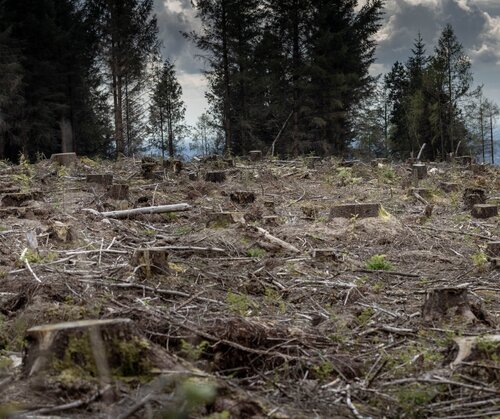
Industrialised forestry – typically, clear-cutting – is the most destructive logging practice on the continent. It is largely responsible for the collapse of Europe’s forest carbon sink and should not be eligible for any ‘sustainability’ certificate. Do those developing the forest management methodology recognise this?
Image: Alex_An_Der/Shutterstock
Categories: News, Forest Watch, European forests, LULUCF