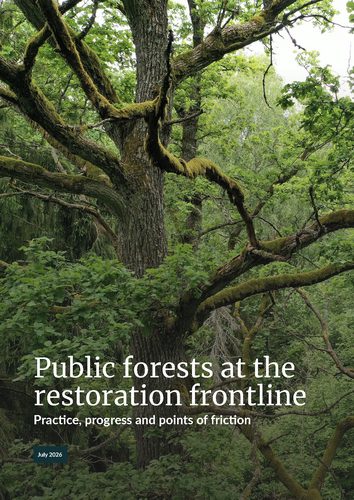
Public forests at the restoration frontline: Practice, progress and points of friction
The necessity of forest restoration is something that very few would doubt. And many of the governments have a tool to achieve this with very few trade-offs – public forests management.
To understand more about public forests, Fern commissioned Mari Arold, Doctor of Philosophy Candidate, School of Geography and the Environment, University of Oxford, to explore the restoration landscape. She found a diverse picture of courageous approaches and seemingly impassable bottlenecks. Where meaningful stakeholder involvement happens, multifunctionality sits at the centre of management strategies and economic structures are used to enable forests to meet multiple needs. But when stakeholders are poorly involved and revenue from wood extraction is prioritised, governance is isolated from social needs, and change is slow and insufficient.
“Public forests at the restoration frontline” offers a useful lens through which to look at the Nature Restoration Regulation. Are the generalised claims about public forests role always true? And are we hearing about the positive examples, or are public forest agencies missing opportunities out of fear of changing business as usual?
The report considers public forests in Denmark, Finland, France, Germany, Latvia, Poland, and Spain, revealing that the EU’s most influential forest management institutions have enormous potential to help the EU to meet its ambition of bringing back nature. Some forests have already been enabled to release that potential, while others are held back by constraints that often have little to do with forests and a lot to do with poor governance and conflicting aims.
Categories: Reports, European forests