Thirty years of action: Interview with Fern Co-founder Saskia Ozinga
5 December 2025
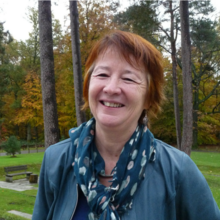
In 1995 Saskia Ozinga founded Fern with Sian Pettman. She has been integral to the unique place Fern occupies in the global forest movement and our singular way of working. In this interview, she reflects on some of the lessons of the past three decades.
I remain optimistic that change is possible.
Would you have envisaged Fern being where it is now when you started it with Sian 30 years ago?
Saskia: No, not at all. I never created Fern with the idea it would be an organisation with 20 staff and a turnover of 4 million Euros. I was just doing what I thought would be useful: supporting the people and organisations I got to know through the World Rainforest Movement to achieve what they wanted to in their countries, after realising that a lot of the problems originate in the Global North. I thought I should do what I could do to change things here that lead to forest loss in the Global South. We started with nothing, just two people, and for the first six months, no funding at all. [Saskia didn’t take a salary from Fern for around two years.] Then we got something like 50,000 Euros from the Netherlands Committee for the International Union for Conservation of Nature, which was a lot of money for us then, and Fern started to grow organically, rather than in a planned way.
Has Fern’s core purpose changed in the last three decades?
I think the core principle that we’re here to work together with organisations in the Global South and now also in the Global North to protect forests and respect rights of Indigenous Peoples and local communities is the same. That's pretty fundamental to everybody in Fern, as is the idea that the organisation has to be jointly run by everyone. I think what’s changed is that we go much deeper into EU policy areas, with more people working on the EU and in the Brussels bubble than before. When we created Fern, we purposely chose to have people working outside the Brussels bubble to make sure that we weren’t drawn into the EU’s agenda too much, which can be a danger – and still is. We must ensure we are agenda setting and not just agenda following or implementing.
How has power shifted within the EU during Fern’s existence – and what does it mean for our work?
Until 1993 the Parliament had very limited power. It was more an advisory body. But later the Parliament became the powerful force within the EU, that it still is. There was this attempt to centralise power in the Commission with various treaties, now there's a tendency to move the power away again from the Commission to the Member States’ level. So these things swing back and forth and there's pros and cons to both of course. Originally, to be closest to the fire, we focused almost solely on the Commission as it drafted the policies and laws. Once the Parliament became co-legislator they became more important. The Council has always been important, but it is difficult to find out Member State positions and know where to focus.
Change has to come from the people on the ground in their country. And to do that, the political situation there needs to allow them to be active enough to be able to change the rules.
Has the role of Indigenous Peoples and local communities in protecting forests changed?
Their role has always been key but in the 1990s Indigenous Peoples’ and local community’s voices weren’t really heard in Brussels. It was mainly the conservation NGOs like WWF and to some extent, Friends of the Earth who worked on these issues. Indigenous Peoples weren’t well organised at the time either. Now, the rights of Indigenous Peoples are centre stage and their voice is loud and clear. That's a big change. The same can’t be said yet of other local communities.
The Forest Movement Europe (FME) has existed for longer than Fern has. As the founder, are there lessons in its longevity for the wider forest movement?
The FME’s origins go back to the 1980s when a group of NGOs from different European countries came together in the Netherlands to support Malaysian and Japanese organisations who were trying to stop Japanese companies from destroying rainforests in Sarawak, Malaysia. Our original name was “Ban Japan from the Rainforest”, and it sort of grew from there – next we became the European Rainforest Movement and then the European Forest Movement after forming the Taiga Rescue Network and including boreal forests. We have stuck with the final FME name for decades.
The fact that the grouping is still going, although young people have replaced most of the original attendees, shows that sometimes you don’t need funding to keep going. As people fund their own travel to the meetings, there's no secretary or staff that need be paid, or anything like that. I think it's critical to think of a movement as something that doesn't need to be funded, because funding can hamper its progress. I often sit in meetings and people say, ‘We can't do that because we haven't got the funding’ - but if you do it the way the FME does, you can. You just need somebody who's committed to calling the meeting and organising it, and then people can take it in turns to organise it every year. This creates a truly sustainable movement.
Where do you see real change coming from next?
[Both geopolitically and ecologically] it’s very grim at the moment. We clearly need radical change but the rules are rigged to favour the status quo. Change has to come from the people on the ground in their country. And to do that, the political situation there needs to allow them to be active enough to be able to change the rules. Hence, we need to always look at the bigger picture, not just what's happening in the forestry sector, but the wider political framework. We need to understand the powers who hinder the change. But without active people on the ground, you can't get change. You need both to work in tandem. When you see active communities in country you know that real change is possible. I remain optimistic that change is possible.
This piece was first published in Fern's 2024 Annual Report.
Image: Fern
Category: News