
Nature: a cheaper, more effective climate and ecosystem solution
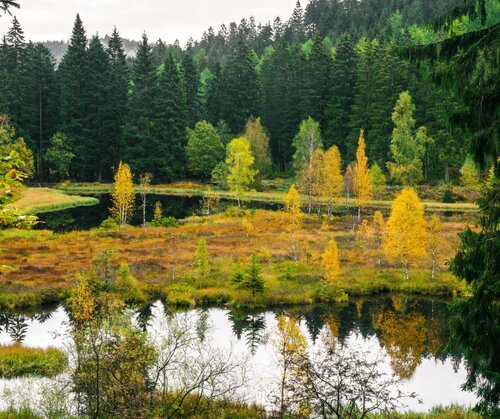
Dr. Stefan Kreft, of German NGO Naturwald Akademie, discusses an exciting new German initiative that, at long last, puts serious funding behind nature-based solutions that serve both climate and biodiversity.
The EU Nature Restoration Regulation, adopted in 2024, requires Member States to submit Nature Restoration Plans by September 2026. Despite watching this deadline approach for two years, many Member States will still miss it; and some are attacking its ambition instead. But the German Federal Government has adopted one sweeping initiative that serves both climate targets and nature restoration goals efficiently and cost-effectively, offering an example for other Member States. Forests will benefit significantly.
Many held the illusion that Germany has had a successful climate mitigation forest programme in place since 2022 - KWM. At a Fern forest finance webinar in September 2025, Naturwald Akademie’s Stefan Kreft corrected that impression: “In fact, that programme is a subsidy hidden behind low-level forest management criteria. Little improvement is required from forest owners.” Climate mitigation funding was tethered to forest criteria so unambitious that KWM is ineffective.
Germany’s new Climate Action Programme, adopted on 25 March 2026, changes this, fundamentally and for the better. Covering forests and land-use but also transportation, energy, housing, the 2026 Climate Action Programme embodies a transformative shift towards nature-based solutions to address the massive challenge that climate change represents.
“Finally, we have arrived at the thinking that it is much better to let nature do the job – to improve biodiversity, climate and ecosystem integrity simultaneously, and not invest all funding into high-risk technologies such as Carbon Capture and Storage,” says Kreft, “or into subsidising business-as-usual forestry.”
This leap forward was not easily obtained: As elsewhere, civil society challenged the Government before the courts for its failures to implement Germany’s Climate Action Law adequately, and won. “The 2026 Climate Action Programme is an attempt to raise ambition and finally meet the Climate Action Law’s requirements, building heavily on nature-based solutions.”
In so doing, it will help advance Nature Restoration Regulation targets considerably. “Nature-based climate change mitigation and nature restoration are in deep synergy, and the German Government’s purpose is clearly to connect both policies. The LULUCF [Land Use Land Use Change and Forestry] part is almost entirely nature based, aiming to strengthen natural solutions to capture and store carbon.”
Still more striking, Kreft adds, is that the Government are backing these commitments with serious funding: €4.7 billion in 2027-2030 will go towards nature-based solutions.
“This is revolutionary. If the government continues to be committed to climate change, they will invest quite big money into forests and other ecosystems, agriculture and peatlands, all types of wetlands and forests. Let me be clear: it still won’t suffice. But we should appreciate that policymaking now has it right: nature is the solution.”
Ultimately, this investment will be more cost-effective than the bottomless remedial funding that public authorities must spend yearly to address the extreme weather events, fires, floods, crop failures and health consequences of climate-breakdown.
Of the 15 Climate Action programmes that concern forests, divided into ‘modules’, the most striking is the ‘Habitats Synergy Module’ (HSM), applicable to the 20% of communal and private forests that are in Natura 2000.
“In terms of ecological improvement, HSM is the most ambitious, and by far the most promising. More money has been allocated per hectare – incentives to coax forest owners into true ecological ambition.”
This ambition is reflected in strong criteria. Module A criteria cover all relevant elements of forest management: tree species composition, canopy cover, deadwood, water management and non-intervention areas …. Module B invites forest owners to set aside a certain part of their forest in exchange for payments calculated to replace foregone profit, allowing for even more significant funding than Module A.
“By incentivising forest owners to transform forest management ecologically, the ‘Habitats Synergy Module’ is – finally, truly – a strong example of how to connect nature-based climate mitigation to nature restoration. Only natural ecosystems are good at capturing and storing carbon, so funding this is not double accounting but synergy, meeting two goals with one policy. Finally, we are acknowledging that natural ecosystems are our greatest potential helpers in climate change mitigation.”
If HSM is successful, future policy-making may wish to expand its scope beyond Natura 2000.
Naturwald Akademie drafted a policy brief, to contribute to Germany’s ongoing (through 25 June) Nature Restoration Consultation and the Nature Restoration Plans that Germany and all Member States must submit by 1 September. Among the briefing note’s recommendations, it encourages forest owners to rely on natural processes already underway that harness ecosystems’ potential.
It calls also on forest owners and their pressure groups to prioritise a strong collaborative approach – far preferable to the current loud lobbying to postpone and empty environmental rules of their purpose. The European public is relying on decisionmakers to acknowledge that nature is a more efficient, more cost-effective ally, already quietly going about the business of restoration and climate mitigation – if we allow it to.
To discuss further, please contact Dr. Stefan Kreft at [email protected]
Image: Wirestock Creators/Shutterstock
Categories: News, Forest Watch, Partner Voices, European forests