Understanding the EU-Congo Forest Partnership
6 January 2025
What does it say, what does it do?
The second-largest tropical forest on earth sits in Africa’s Congo Basin. Much of that forest grows in The Republic of Congo (RoC). The EU and RoC signed a Forest Partnership in 2022. Two years into implementation, this brief considers how to understand this brand-new instrument.
What is in the EU-Congo Forest Partnership?
The EU-Congo Forest Partnership (FP) is a bilateral agreement between the Congolese government and the EU. The parties agree to cooperate to increase forest, mangrove and peatland areas, reduce or stabilise deforestation rates, and increase employment in and commercialisation of Congo’s forests. The agreement takes the form of a Memorandum of Understanding (MoU), a formal, yet non-binding agreement that outlines the intentions, roles, and objectives of the parties involved in a collaboration. It is not legally enforceable.
The MoU (2022) sets out the five key work areas, and an implementation roadmap (2023), gives more clarity about implementation priorities.
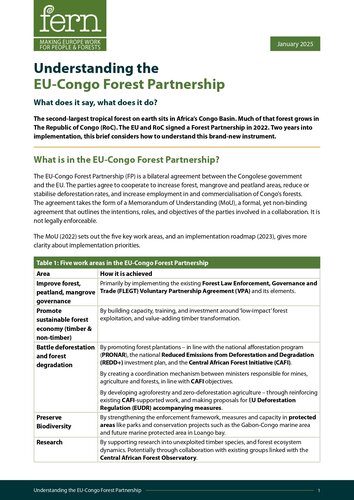
Five work areas in the EU-Congo Forest Partnership
Area | How it is achieved |
| Improve forest, peatland, mangrove governance | Primarily by implementing the existing Forest Law Enforcement, Governance and Trade (FLEGT) Voluntary Partnership Agreement (VPA) and its elements. |
| Promote sustainable forest economy (timber & non-timber) | By building capacity, training, and investment around ‘low-impact’ forest exploitation, and value-adding timber transformation. |
| Battle deforestation and forest degradation | By promoting forest plantations – in line with the national afforestation program (PRONAR), the national Reduced Emissions from Deforestation and Degradation (REDD+) investment plan, and the Central African Forest Initiative (CAFI). By creating a coordination mechanism between ministers responsible for mines, agriculture and forests, in line with CAFI objectives. By developing agroforestry and zero-deforestation agriculture – through reinforcing existing CAFI-supported work, and making proposals for EU Deforestation Regulation (EUDR) accompanying measures. |
| Preserve Biodiversity | By strengthening the enforcement framework, measures and capacity in protected areas like parks and conservation projects such as the Gabon-Congo marine area and future marine protected area in Loango bay. |
| Research | By supporting research into unexploited timber species, and forest ecosystem dynamics. Potentially through collaboration with existing groups linked with the Central African Forest Observatory. |
The main work areas overlap with activities envisaged in existing international RoC forest initiatives, most notably the FLEGT VPA and the CAFI letter of intent (see table above). It is clear that fully implementing the FP will rely on continuing existing partnerships.
‘New’ work within the FP mostly concentrates on stimulating greater private sector engagement, creating jobs in forest domains, and improving the commercial viability of forest sector activities. This aims to be in line with the EU Global Gateway approach.
The roadmap also lays out two additional categories of activity (see table below). These are concerned with putting the partnership in to practice.
FP Roadmap additional work areas
| Political and strategic dialogue | Activities linked to overall functioning of the FP, particularly creation of the political and technical working groups. |
| Sources of finance | Two key goals: improve access to finance in the forest sector, and make new finance opportunities available. |
What kind of instrument is the Forest Partnership?
The FP is:
- An umbrella agreement in the form of an MoU between the EU and RoC that addresses many aspects of RoC’s forests.
- A joint initiative of the EU, France and Germany
The FP is NOT:
- Legally binding for either the EU nor the RoC. This means there is no formal role for the European Parliament or Council.
- A commitment to increase funding for RoC’s forests.
- A pathway to preferential treatment or EU market access
The FP differs significantly from the other two major international forest initiatives in RoC in several ways.
First, the FP has not been developed around a specific international instrument or target. The VPA (built around delivering FLEGT-licenced timber), and the CAFI letter of intent (built around implementing the national REDD+ investment plan) are explicitly tied to broader international incentives and commitments. In contrast, the FP brings together disparate and overlapping domains, providing an overview of the major areas of intervention in RoC’s forests.
Second, unlike the VPA, the FP is not legally-binding and does not create obligations for both parties.
Third, although the CAFI programme is a non legally binding donor initiative, it ties continued funding to commitments and requires inclusive, participatory and transparent implementation.
With neither financial incentive nor legal force, the FP is not well set up for sustainable implementation as there is nothing to stop parties walking away if political priorities shift. They can work on ‘easy’ or ‘attractive’ parts of the workplan but sidestep more challenging aspects.
In RoC, the main commodities affected by the EUDR are wood and cocoa. The VPA process should help RoC’s timber sector achieve EUDR compliance, as it will deliver traceable and verifiably legal wood. The EU and two Member States (in this case, France and Germany) have agreed to support FP implementation.
This should allow more coordinated and effective spending and could also help increase diplomatic pressure for implementation. Although it took time, the VPA achieved genuine progress in RoC and is testament to the political will for forest sector reform that has been nurtured. There is an on-paper commitment to press ahead with the VPA process, including through the FP, and it will be important to ensure that, in practice, the FP is used to support ongoing VPA work.
In sum, the FP can be seen as a convening framework and fund management tool that allows contributions to be considered together before dispersal, and stakeholders to see the totality of forestcentred work. The FP may clarify gaps not addressed through existing processes or projects, but it lacks the focus, structural accountability, and incentives to address those gaps.
How is the Forest Partnership being implemented?
Two years into implementation, there is little public information available about how the EU-Congo FP is working. Although there is no real structural accountability built into the FP the text promises that the Partnership will be ‘open, inclusive and transparent’.
RoC NGOs report that the FP development was not open, inclusive or transparent. The MoU was signed by the Parties before civil society or private sector actors had seen its content, much less had a chance to influence its scope or priorities.
Implementation Commitments | Implementation in Practice to date | |
| Open | X |
|
| Inclusive | X | Some efforts made to invite members of civil society and private sector to preparatory meetings around political working group meetings, but not clear on what basis they were selected. Role in implementation of FP not clear. |
| Transparent | X |
|
The Forest Partnership and the EU Deforestation Regulation
The EUDR will be applicable from the end of 2025. It requires relevant forest-risk commodities to be verifiably deforestation-free and legally produced before entering or exiting the EU market. It also commits the EU and third countries to jointly addressing the root causes of deforestation and forest degradation.
The FP roadmap specifically includes conducting an ‘analysis of the implications of the EUDR in the national context, and proposals for accompanying measures.’
If done well and in an open and inclusive way, this could help clarify how the EUDR could affect the lives of some of RoC’s forest dependent communities, and how to mitigate potential harm. This analysis also demonstrates that the FP as a whole, is not in and of itself an ‘accompanying measure’ for the EUDR.
Key findings
- The Forest Partnership relies on effective implementation of existing programmes (especially the VPA), to be successful.
- The Forest Partnership cannot be considered an EUDR ‘accompanying measure’, but it opens the door to identifying what effective measures might look like.
- The Forest Partnership is not structured to promote accountability or long-term commitment to implementation as it is neither legally-binding nor tied to incentives.
- The Forest Partnership is best thought of as a coordination tool, providing a framework to help RoC Ministries and European funders to coordinate.
- The development of the Forest Partnership, and its implementation so far, has not been ‘open, inclusive and transparent.’ This significantly limits its potential to be effective.
Conclusion
If efforts are made to make it inclusive and transparent, the RoC Forest Partnership may turn out to be a valuable tool that drives positive changes in Congo’s forests. It cannot, however, and was not designed to, replace existing ongoing processes most notably the FLEGT VPA. Similarly, it won’t fulfil the EU’s commitment to develop EUDR accompanying measures, even though it does open the door for their development.
Categories: Briefing Notes, EU Partnerships, EU Regulation on deforestation-free products, The Republic of Congo