
A forest threat from another quarter: Support Ghana’s fight against galamsey
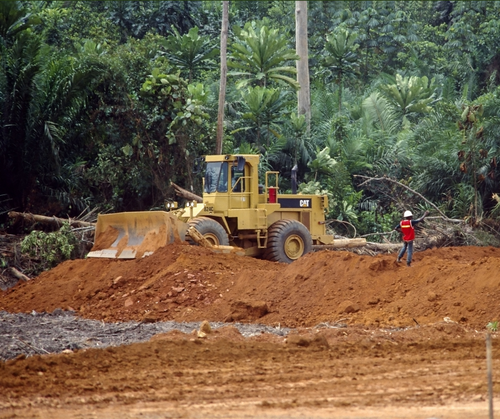
Fern partner A Rocha Ghana sounds the alarm on illegal small-scale gold-mining that threatens communities, forests and water resources.
Ghana is struggling to control rampant illegal, small-scale gold-mining that is threatening forest reserves, contaminating water quality and arable land, harming human health and exposing Ghanaians to human security risks.
As Ghana and the EU celebrate the inclusive Forest Law Enforcement, Governance and Trade (FLEGT) partnership that has improved forest governance and spurred a decline in illegal logging, A Rocha Ghana urges them to explore existing avenues of cooperation, lest this new threat sweep aside the hard-won gains of previous decades.
“Ghana is a country blessed with so many natural resources. From the 14th century, gold-mining was carried out in a regulated manner; up until recently, large-scale companies had mining concessions, small-scale miners obtained licences,” explains Daryl Bosu of A Rocha Ghana. “Ghana benefited significantly, and communities were supported.”
The gold-rush of the past two decades has spun out of control, however. Bosu lists contributing factors: “Regulatory safeguards that exist on paper have not been monitored for compliance, or enforced. Mercury contamination linked to gold-mining is catastrophic, but even legislation implementing the 2013 Minamata Convention on Mercury is not applied in practice. The previous Government even passed legislation, LI 2462, that exposed all state-owned forests reserves to mining, including globally significant biodiversity areas, which are historically protected and exempted from extractive ventures.
In this context, ‘galamsey’ – unlicensed, small-scale gold-mining – has emerged as a particularly complicated threat; high gold prices have drawn in many who, driven by poverty and the scarcity of profitable alternatives, cannot turn down the allure of the illicit income. By 2023, Ghana had become Africa’s largest gold producer, 10th globally. Gold production is soaring, driven by the upsurge in small-scale mining that now accounts for some 35% of the country’s total gold production. Although galamsey and small, licensed operations are often indistinguishable, Ghana expects to increase small-scale gold production to reach US$12 billion in 2025.
“Prior to 2025, our currency was performing terribly, relatively speaking. We were struggling as a country: inflation was soaring, food prices were at an all-time high, we had significant domestic and international debt …. Gold has been used to shore up local prices and stabilise the situation. But while we have taken the gold, we have not paid attention to the social and environmental consequences.”
The consequences are vast and severe, for Ghana’s natural resources and the health of its population.
“The mercury, and cyanide used in gold extraction, and ore associated metals such as arsenic and lead have contaminated about 60% of Ghana’s water bodies,” Bosu says. “Arable lands are degraded, with toxins bioaccumulating in fish and entering the food chain – so much so, that the EU has cautioned Ghana that its farm produce could be prevented from entering EU markets. Also, the polluter definitely does not pay here. This rapid expansion has happened with the complicity and corruption of certain officials, and agencies supposed to ensure compliance are compromised or limited in capacity.”
Worse, severe health consequences affecting local populations include an upsurge in organ dysfunction and deformities at birth. Untrained galamsey operators expose themselves and others to harm, indiscriminately using, for example, up to four times the amounts of mercury needed to extract gold from ore amalgam.
Forests undergo a double increase in pressure. They are cleared directly in mining operations, but also indirectly: as waterways and arable lands are poisoned, communities push deeper into forest reserves to find land to cultivate safely. This is unsustainable: Between 2001 and 2022, Ghana lost 1.53 Mha of tree cover, equivalent to a 22% decrease in tree cover since 2000, with a corresponding drop in sequestration of 843 Mt of CO₂e.
Two decades of FLEGT implementation have transformed governance in the timber sector, and Ghana’s licences are just now being issued (FW 308), but gains here are now under threat: the timber industry is also alarmed by the encroachment of gold-mining into forest reserves. Communities, and especially women, lose once again: their livelihoods depend also on non-timber forest products (NTFPs).
“Galamsey has not only displaced communities and poisoned land and water systems, it is devastating cocoa farms, and Ghana’s cocoa production has dropped significantly,” Bosu adds.
Together Ghana and the EU have laid important groundwork that may help furnish a solution.
Bosu is project coordinator of the EU-funded BRACE project, which takes a practical approach to imposing limits on galamsey. A Rocha Ghana leads the civil society consortium helping communities not to be caught off guard when mining operations suddenly turn up on their lands.
“We give communities training to know their rights, and practical tools needed to defend them: we are setting up an online monitoring platform to report violations that targets youth, women and traditional authorities. We’re also creating a network of community paralegals, and a Legal Access Fund to support them, giving them training to seek legal redress.”
Traceability: A further difficulty is that illegal gold, once it hits the market, is indistinguishable from legal gold. But two decades of efforts to prepare timber traceability under FLEGT, and more recently the Ghana Cocoa Traceability System created to comply with the EU Deforestation Regulation, have made strides in the practicalities of geolocation. These could lay the cornerstone of traceability in gold production and mining activities.
The EU is not a principal importer of Ghanaian gold, but its long-standing relationship with Ghana means that various frameworks could be explored to help Ghana protect its population and forests from the toxic encroachments of illegal mining. A Rocha Ghana urges the EU to bring increased attention to galamsey within the existing FLEGT agreement, forthcoming Forest Partnerships, initiatives under the EU Critical Minerals Regulation and the Teams Europe Initiative – even joint programmes under the aegis of the Minamata Convention on Mercury, as both Ghana and the EU and its Member States are signatories. Much more than forests are at stake.
* Sources for this article: Dr. Kwadwo Ansong Asante and Dr. Lydia Osei, “The Ecological Damage of Illegal Mining in Water Bodies and Forest Management in Ghana,” July, 2025; Daryl Bosu, “Minerals and Mining Governance in Ghana: Trends,” A Rocha Ghana, 2025; Daryl Bosu, “Galamsey – the State of Play,’ A Rocha Ghana, 16 January 2025.
Image: Klaus Oskar Bromberg/Alamy
Categories: News, Forest Watch, Partner Voices, Ghana