How to make meat production more sustainable?
For meat to remain a part of European diets for years to come, we need to ensure we can produce it sustainably.
That is presently not the case.
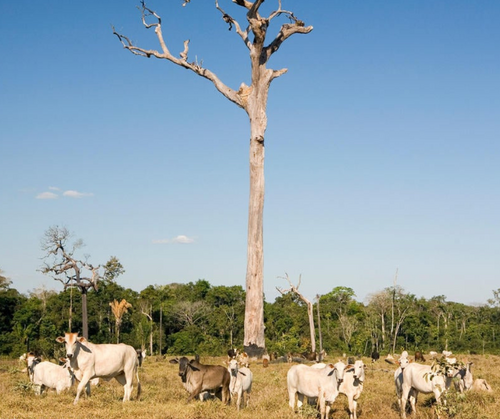
European meat consumption is deforesting forests globally due to imports of the soy we use for animal feed, which has played a major role in the destruction of forests in South America. Sustainable meat production therefore requires us to reduce our reliance on imported soy and focus more on domestic protein production. EU policies can support farmers to move from using imported soy, to supporting farming models based on protein grown in Europe.
If the EU-Mercosur Free Trade Agreement goes ahead, tariffs on soy and beef will decrease, making it even more attractive to import these products to the EU – despite the risks to the Amazon. Please see Fern's analysis of the Mercosur agreement - we must ensure it does not result in massive imports of deforestation-causing beef and soy.
Fern’s work on meat
What do Fern and our partners want?
Complex problems are not best solved by nudging individual action, but by delivering policies that lead to large-scale positive change. Fern and our partners therefore aim to reshape food environments to allow consumers to choose healthy and sustainable food – something EU consumers consistently show they want.
One clear example is the EUDR which aims to end imports of commodities that have caused deforestation – including many meat and animal feed products. Our beef briefing and our soy briefing outline the problem and solutions in more detail. It is important to remember, however, that as well as ending imports of deforestation-risk commodities, policies need to encourage EU citizens to reduce meat consumption to sustainable levels.
What is Fern doing?
We are looking for affordable policy-solutions that will reduce meat consumption to levels that no longer threaten forests or livelihoods and that improve EU citizens’ health. Responsibility needs to sit with the large multinationals that supply much of the protein consumed in the EU.
So far, we have found that the most viable policy levers are:
- The Common Agricultural Policy
- The Framework for Sustainable Food Systems
- The Carbon Farming Initiative
We will continue to monitor opportunities to have a beneficial effect on forests, the people who depend on them, and people producing and eating food in the EU.
How does meat affect climate change?
The meat industry is responsible for a large share of global greenhouse gas emissions, primarily carbon dioxide, methane and nitrous oxide, caused by land use change (including deforestation), emissions from cattle and manure, feed production and transportation.
Meat production also requires vast amounts of land, water, and energy, contributing to deforestation, water scarcity and biodiversity loss.
Is meat production decreasing?
Total global meat production is five times greater today than 50 years ago, amounting to more than 350 million metric tons each year. Despite a slight decrease in per capita meat consumption in the last few years, Europeans and Americans consume respectively 80 and 110 kilograms per person annually. Global meat consumption is expected to grow by 14 per cent by 2030, increasing meat sector emissions by five per cent.
What has been achieved so far?
Fern was the first NGO to call for the EUDR, a new Regulation which requires that products coming into the EU must be free from deforestation, forest degradation, and violations of law in the country of production. If the Regulation is properly implemented, it will mean that beef and soy (as well as other products) coming into the EU has not caused deforestation or land rights violations.
Although this is an important and hard-won step forward, it does not mean EU meat and dairy consumption will stop contributing to these problems. Firstly, the Regulation's land rights protections are based on domestic rather than international law, leaving communities vulnerable to domestic problems such as those recently inflicted by the Bolsonaro regime in Brazil.
Secondly, because the EUDR does not cover other ecosystems like the Brazilian Cerrado – itself an important carbon stock and wildlife habitat—destructive production may simply move into these ecosystems, increasing carbon emissions and species extinction there.
Thirdly, if EU meat consumption remain high, the Regulation will mean deforestation-free areas are “commandeered” to supply the EU market, with production for other regions moving further into forest areas—a phenomenon known as “leakage”.
What needs to happen to achieve our recommendations?
Academics, NGOs, economists and health experts agree that meat and dairy consumption is out of control and yet EU policies continue to encourage it. The EUDR needs to be well implemented by Member States to ensure that only deforestation-free meat and feed arrives in the EU. This will, however, only deal with the supply side issue, the EU needs to pursue demand-side policies that place requirements on large corporations to ensure what they sell to consumers is healthy and sustainable.