
Building a better bioeconomy
12 Juni 2025
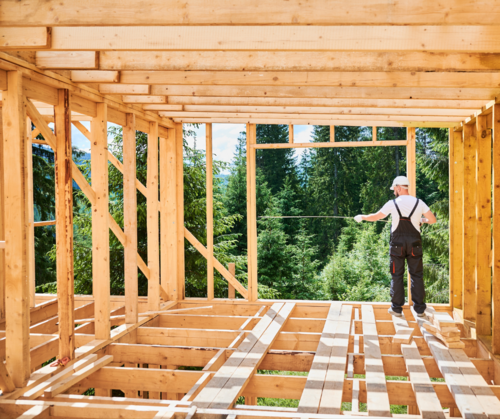
How the EU’s new Strategy can boost rural livelihoods and sustain forests
Hannah Mowat, Fern’s Campaigns Coordinator welcomed the group and explained our hope that the event would raise the voices of people who live and work in the forests and whose voices are not normally heard in Brussels.
Maria Ohisalo MEP encouraged all to input to the Bioeconomy Strategy consultation which is open until 23 June 2025. She spoke of how powerful a force the bioeconomy could be if it respects natural and climate boundaries. She said that while the bioeconomy is more than biomass, the two cannot be separated – for example, using biomass for energy is an ongoing problem, including in her homeland of Finland.

The Bioeconomy will only work if EU forests are resilient
Jessika Roswall, Commissioner for the Environment, Water Resilience and a Competitive Circular Economy explained the importance of getting a large and wide variety of inputs to the Bioeconomy Consultation. This is an issue that affects us all as forests deliver water, air, culture, tourism, and increasingly “bio” elements such as plastic and chemicals. Wood is a great store of carbon when used in buildings and car interiors etc. but the Bioeconomy will only work if EU forests are resilient. The EU excels at innovation but often fails to turn innovations into sustainable businesses. We also need a bioeconomy that rewards those who preserve ecosystems and links with the Clean Industrial Deal. She encouraged participants to share stories, struggles and ideas about how to build local value chains.
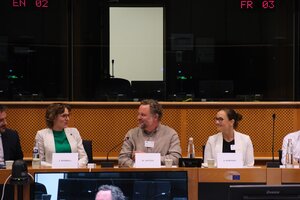
We focus on extraction and cost minimisation – which is a problem as humans are the cost we are trying to minimise
Reflections from a forester, Martin Jentzen said that forestry today works for wood processing industries but not for rural communities. We focus on extraction and cost minimisation – which is a problem as humans are the cost we are trying to minimise. In response we must focus on high-end products, not just pulpwood, and look to increase value, not volumes. Biomass is a limited resource and we need to make small changes to use it better. We also need to think in the long term, for example, we used to remove birch trees as we thought they had no value but now it is one of the most valuable species but requires years to grow. We need to future-proof the bioeconomy and one way to do this is to go from clear-cut to continuous cover forestry. Society is asking for higher quality timber so let’s deliver it and let’s grow forests for a future where we could get paid for the ecosystem benefits of forests. Diversifying forests and forestry will have an impact on the future of forests. Ecological risk = economic risk. “Our ecosystems and economies are so intertwined that what we do in our economy effects our forests and vice versa”.
Augustyn Mikos from the Environmental Paper Network and Pracownia said the question is how to protect the forest while delivering enough wood for the economy. As such the elephant in the room is that currently more than 50% of the wood extracted in the EU is burnt (the worst possible way to use wood). If you add pulp and paper, you see the vast majority of biomass is used for low value products. We need to save the wood industry and increase protected areas, this can only be done by reducing wood burning and paper use.
Pieter-Jan Desmet from Decospan said that veneers and panels is the highest value wood from the forest but only makes up 1%. In his industry, it is a huge problem that 50% of the wood is burnt and it is also a problem that we allow much of our good wood to be bought by foreign buying companies (mostly based in China) for processing, before buying it back into the EU. We need more industries in the EU and stop haemorrhaging these jobs.
Dorthea Wabiser from the NGO Pusaka in West Papua reminded us that the choices the EU makes in the bioeconomy have impacts on tropical forests since the EU already currently imports a lot of biomass. This has an impact on Indigenous Peoples who have been fighting to protect their forests for decades who are now facing a new struggle as forests are being turned into sugar cane etc. for the bioeconomy.
Julia Bos from Oxfam shared the civil society statement on the bioeconomy.
Marcus Walsh also spoke as a forest owner, explaining that he recently sold good quality pulp wood to a go-between, who then sent it to Poland to burn. This was good wood that could have been used for other things but - due to subsidies – they could afford to do this. He said that Rotational, clear-cut forestry works only if you forget about water, air, culture, biodiversity and other benefits. It works but it is very expensive in terms of everything else. He finished by saying that if you think that existing certification schemes are working then you are blind to reality.
Toby Akroyd warned that BECCS and burning is a disaster and spoke about a new report showing that changing to a real bioeconomy will help the EU achieve its environmental and economic targets.
Commissioner Roswall thanked everyone for the comments and said that one pillar of the bioeconomy is innovation, the other pillar is decarbonisation, and that she agrees we need to keep biomass in the system as long as possible. She said maybe we should talk about the circular bioeconomy - it is 5% of EU GDP and 10% of EU jobs and can help us be more resilient. She also recognised that we need a level playing-field.
The furniture industry should not be fighting to keep wood out of the furnaces
Michal Wiezik MEP said that the bioeconomy a good idea that went horribly wrong and we see bad scenarios all around the world. Forests in Europe are not in a good situation. Fast growing species are now fast dying forest stands. We keep saying we have more forests than ever but that is just on the surface. We are gaining mass but it is like you celebrate putting on fat rather than muscle. The cascading principle is good but needs to be bullet-proof. The furniture industry should not be fighting to keep wood out of the furnaces. If there are no resilient EU forests then there is no resilient bioeconomy. The bioeconomy cannot be based on imports – importing from Canada to burn in the UK is not viable. The EUDR will really help with this, and if we do not have this tool in the field there are risks that degradation will continue, that we will continue to gain fat not muscle. The bioeconomy must also steer clear of old-growth forests. If we continue to lose old growth forests at the speed in which we are in Romania and the Carpathians then we know the Bioeconomy has failed.
Anu Korosuo asked how to future-proof the Bioeconomy and gave a presentation on behalf of the EU’s Joint Research Centre (JRC). She said that 82% of the 1.2 billion tons of dry biomass is from primary sources, 27% of which is from forests. Of this, 9% is used for plant based foods, 38% for animal feed, 22% energy from woody biomass, and 22% wood and paper products. She said that it was hard to give all the statistics she would like to as it is a challenge to get up to date data from Member States. She asked all to check out the “knowledge centre for the Bioeconomy”, and a participant suggested that this is why we need the Forest Monitoring Law.
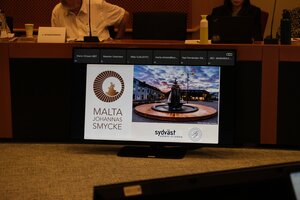
What could have been chipped and burnt, is now at the heart of a town, and increased income, visibility and pride – this is the bioeconomy at work.
Anna Johansson told a story of how she made a large fountain bench installation in Sweden called Malta Johannas Smycke. She wanted to make a contemporary design rooted in local heritage which meant working with Elm. Elm are dying because of Dutch Elm disease and so could only be chipped and burnt, but she showed that these trees could be used perfectly well for the bench, and in fact it was a very efficient use of this wood because the dying process of the Elm dried it, meaning the timber did not need additional drying as it often does. But this is not a story about a bench, but about value chains, and about making space for small scale actors. What could have been chipped and burnt, is now at the heart of a town, and increased income, visibility and pride – this is the bioeconomy at work.
Pieter-Jan Desmet explained that Europe is not protecting its industry. For example, the French primary processing (‘slicing’) industry had disappeared. He said that before it joined the EU, Croatia was a good example as it banned log exports. After joining the EU, it came under pressure to open its borders and the wood started leaving. Once the local processing economy disappears, it becomes impossible to get the full forest value. He stressed the importance of generating high value products through local use of resources and described the EU Deforestation Regulation (EUDR) as one of the best initiatives he had ever seen, but only if other countries join in with the aim of achieving a fair and balanced playing field. If that doesn’t happen American hardwood producers might be tempted to sell to China rather than the EU.
[Skogsportalen] gives more value to forest owners, and helps timber buyers find the wood they need locally
Rickard Troeng talked about a digital platform he had built, Skogsportalen, to help forest owners and professionals seeking specialised timber to connect, linking buyers and sellers. This gives more value to forest owners, and helps timber buyers find the wood they need locally. Rickard grew up on a farm in a family of farmers and foresters, but himself followed a different path, becoming a computer enthusiast. Skogsportalen helped him combine his interests. He noticed that local sawmills, like the one his father used, were often run by talented entrepreneurs who struggled to find customers due to limited marketing resources and no webshop, so he created the platform to support them. The platform functioned as a marketplace providing entrepreneurs with essential tools like payment processing, all within a user-friendly system. He gave an example of a frustrated forest owner who was told by large contractors they would not pay extra money for the oaks on his land, as they could only be burnt. Through Skogsportalen, the forest owner found a local contractor and a small company that made whiskey barrels, creating a local value chain and jobs. Rickard believed that such services were necessary to generate more value from local forests and foresters, and he was still looking for investors to support the platform.
Biomass cannot fully replace fossil fuels because there are planetary limits, and we’re already using more biomass than what is sustainably available
Joachim Spangenberg argued that bioeconomy is not inherently sustainable and needed to be carefully managed, for example put putting food production first. He emphasised that large- operations like monoculture forestry and big biorefineries might achieve economies of scale but in the process they cause severe ecosystem damage and offer little local employment. He highlighted that biomass could not fully replace fossil fuels because of planetary limits, noting that current biomass use already exceeded sustainable thresholds. He criticised misguided policies that increase biofuel use. He advocates for strict limits on biomass extraction, with EU regulations enforcing social and environmental standards, including fair wages for forest workers. Overall, he believes in capping biomass use, recognising ecological boundaries, and balancing social considerations.
Q&A
Zoltan Kun from Wild Europe & Forest Defenders Alliance warned of the shift from the Green Deal to a Competitiveness Deal before the former is embedded, stressing that true competitiveness requires a healthy biosphere and the restoration of ecosystems like forests. He emphasised that the bioeconomy should also focus on non-extractive functions such as the water cycle and tourism. He called for public forests to lead by example, support environmental targets, and said the Bioeconomy Strategy will only work if there is a Forest Monitoring Law.
Matteo Mascolo from the Forest Stewardship Council addressed the JRC report, highlighting the urgent need for safeguards as wood demand was expected to rise sharply. He argued against a “no-risk” category in the EUDR, warning that it would undermine the Regulation entirely. He noted that benchmarking could be a useful tool, but insisted that simplification must not come at the expense of environmental responsibility.
Katarina Schwartz, Head of the Bioeconomy Division at the German Ministry of Environment explained that Germany’s biomass strategy had failed due to political instability and powerful energy-sector lobbying, noting a lack of coordination among competing industries and environmental NGOs. She asked the JRC whether they were working on future biomass scenario estimates, as Germany had attempted to do until 2050.
Anu Korosuo from the JRC responded that their upcoming report would be broader than the 2020 version, which had focused primarily on bioenergy. They explained that current data on bioenergy was even poorer than before, and that data collection and reporting structures had changed, making comparisons difficult. They confirmed that scenario work was ongoing.
Fanny-Pomme Langue from the Confederation of European Private Forest Owners (CEPF) stated that the bioeconomy was one of their top priorities. She emphasised that forest owners currently faced uncertainty and needed to be motivated to manage their forests. She called for a balanced strategy that reflected all forest functions, supported diversification of revenue streams. She stated that mechanisms like nature credits should remain voluntary mechanisms.
Ulrike Eppler from denkhausbremen stressed the importance of involving all stakeholders and confronting the realities of planetary boundaries and unsustainable, linear economic structures. She argued that the idea of simply replacing fossil fuels with biomass was flawed and called for a rapid departure from practices like wood burning and clear-cutting. She urged policymakers to recognise that ecology was the basis for long-term economic stability and hoped the Bioeconomy Strategy would connect with other EU policy files accordingly.
Hannah Mowat of Fern concluded by expressing admiration for the optimism and diversity shown by bioeconomy entrepreneurs who spoke. She highlighted the importance of ensuring a level playing field across regions and products, especially as forest-related jobs are disappearing. She called for a biodiverse and adaptable bioeconomy that provides meaningful value for both forest owners and processors in a rapidly changing natural environment.

Hosted by Members of the European Parliament Maria Ohisalo (The Greens/EFA) and Michal Wiezik (Renew Europe), this event was co-organised by Fern, denkhausbremen, Birdlife Europe, the European Environmental Bureau, and Oxfam.
Images: anatoliy_gleb/Shutterstock, Fern
Categories: Events, Bioeconomy, Bioenergy, European forests