
Church of Sweden could lead EU towards truly sustainable forestry
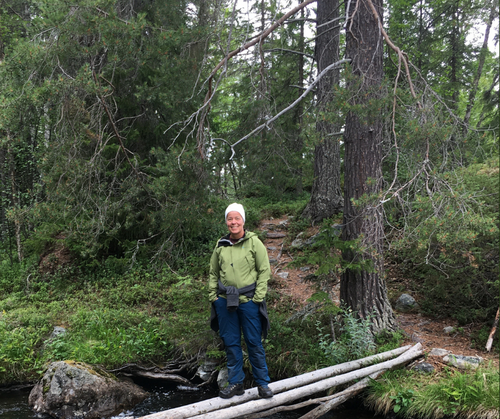
The Swedish Society for Nature Conservation draws attention to a situation now playing out in Sweden – among the EU’s most forested Member States – that could model truly sustainable forestry. Or fall short.
With various forces aligned against it, Sweden’s fifth-largest forest owner, the Church of Sweden, has been building up the courage to take exceptional action to protect forests, biodiversity, climate and Sweden’s Indigenous Peoples, the Saami. Though on a smaller scale, the Swedish situation reflects pressures and opposition familiar at the EU level.
“If it follows through, the Church would set a new course towards sustainability in Sweden, and could provide an influential model to EU Member States of a more reasoned, sustainable type of forestry,” says Malin Sahlin, of the Swedish Society for Nature Conservation.
She went on to explain that in 2024, the Church carried out an investigation into how its forest management could become economically, environmentally, socially and spiritually sustainable. The public response to the Church’s consultation was exceptional for such an endeavour: some 1,2OO replies, the vast majority favouring greater forest protections.
On the basis of its investigation, the Church published its Forest Inquiry, a report that proposes a major transformation of the Church’s forest management approach, and underscores the need for bold measures. Among other things, it calls:
-
To expand biodiversity conservation and carbon sinks, with the aim of setting aside 20% of currently productive forests by 2030;
-
To convert 33% of the managed areas to close-to-nature management, and in the remaining areas, clearcuts must be smaller with greater environmental consideration;
-
To strengthen transparency by increasing local participation;
-
To formally recognise Indigenous rights; to integrate free, prior and informed consent (FPIC) into procedural requirements; and to give greater consideration to Saami livelihoods, and increase their influence in decision-making.
During the investigation, when researchers met with administrators of property and diocese to present and explain its goals, the Forest Inquiry elicited little negative reaction… although it did come soon after publication. ENSO – ‘an opaque entity operating outside the Church’s public access regulations’ that coordinates the dioceses’ forest management, and over which even the Church has little oversight – quickly set up its own, ‘shadow’ investigation, based overwhelmingly on economic criteria.
This counter-investigation requested new analyses from Swedish University of Agricultural Sciences (SLU) researchers, using alternative data. SLU initially refused, but was brought to heel by messages expressing loss of trust, disappointment and the possibility of withdrawing collaboration and church funding for multiple projects and trials – as revealed in an SMB (Supermiljöbloggen, a non-profit environmental news blog) review of voluminous email exchanges, and reported in the Daily News and on the ‘Ekot’ radio show.
The counter-investigation’s results, published on the Gothenburg Diocese website, claimed economic losses in the first 10 years roughly three times the Church’s own estimate; the other elements highlighted in the Church’s report – biodiversity conservation, carbon storage, reduction of Saami conflicts – received little to no attention. Certain dioceses began to present this alternative research as fact to influence local church debate – drawing criticism for sabotaging the democratic process.
That counter-investigation has had an undeniable impact. The proposal published by the Church Board in June 2025 for the Synod’s consideration shows that its courage is wavering; it avoids the thorniest issues (how much forest to protect, how to implement close-to-nature forestry, how to rein in clearcutting) and drops quantitative targets, leaving this to the dioceses, where ENSO’s counter-attack is strongest.
In Sweden’s foremost daily newspaper, and in the Church’s own magazine, Göran Enander, who had led the Forest Inquiry, expressed his deep disappointment that the Church could fail to seize the opportunity it has been given.
The fight is not over. “For more than a year, the SSNC has been following the developments closely,” says Sahlin. “We have carried out a survey, to be published by end of August, that examines the stances of political parties within the Church on a national level, on the important issues the Forest Inquiry raises. We’ll report the results to the parishioners – about five million of them – who are eligible to vote in upcoming Church elections.
As with any election, a great deal will depend on who shows up. The Church elections, 21 September 2025, will determine the new General Synod – essentially the Church’s Parliament – who will, in turn, make final decisions about the above proposal for Church forestry, during its 17 - 19 November session.
Sahlin is hopeful: “Last election, the forest was a major issue, and because of all that has happened, and the attention it received, forests may be an even bigger issue this year.
“The best thing to come out of this is that the Church now has an opportunity to become the best forest manager in Sweden – a huge example nationally, but also in the EU, because they’re so large. The road has been very bumpy, but the Church has a plan, and a chance to set it in motion. We will now see if they dare to rise to the moment, and to care for their forests with the respect that a church should show to nature.”
Categories: News, Forest Watch, Partner Voices, European forests