Financing Europe's forest restoration
26 September 2025
On 25 September 2025 Fern hosted a webinar for foresters looking at what forest financing is available. This event, moderated by Fern’s forest and climate campaigner, Kelsey Perlman, featured speakers Metodi Sotirov (University of Freiburg), Anne Crespin (Forêt Nature) and Stefan Kreft (Naturwald Akademie). They discussed the use of public funding for a just transition to a socially, environmentally and economically resilient forest industry.
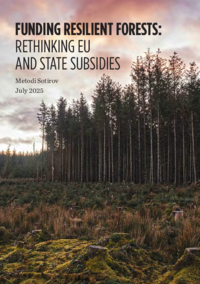
Dr Metodi Sotirov presented the findings of his latest report on European forest subsidies, Funding Resilient Forests: Rethinking EU and State Subsidies. The study finds that public funding is essential for incentivising sustainable forest management geared towards non-marketable goods like biodiversity, climate resilience, and recreation, justifying state intervention. Dr Sotirov analysed public funding schemes across the EU and national levels, classifying them into three main clusters based on their environmental impact (Environmentally Friendly, Environmentally Harmful and Mixed Impact).
The consequences of the current misuse of public forest funding, where harmful subsidies prevail, contribute to continued biodiversity loss and a reduction in carbon sequestration. Dr Sotirov called for harmful subsidies (especially for biomass, monoculture and clear-cutting) to be phased out and funds re-allocated to environmentally sustainable forestry.
Furthermore, Dr Kreft discussed the German Federal Action Plan on Nature-based solutions, which includes two key schemes: the Basic Climate-adaptive Forest Management (CAM) Scheme, and the Ambitious Scheme (CAM Plus). This ambitious plan faces significant challenges, including current budgetary struggles that threaten its full implementation. For Dr Kreft, compliance with both schemes is questionable, as they are audited by third-party certifiers, and the quality of this auditing is deemed a "black box" which lacks transparency.
Anne Crispin presented the work of her organisation, Forêt Nature, a Belgian non-profit promoting resilient management, mainly through Close-to-Nature Forestry, which focuses on training, communication, and project management. She reiterated the importance of training foresters, as they are key to implementing restoration measures. This makes permanent funding for training and advisory services fundamental to ensure they have the necessary knowledge and skills. The fact that the crucial Close-to-Nature Convention in the Walloon Region, where Crespin works, was cancelled due to budget issues perfectly demonstrates her conclusions.
Webinar presentations available here.
Categories: Continuous cover forestry, European forests