
How the EU’s Deforestation Regulation can strengthen forests and the forest industry
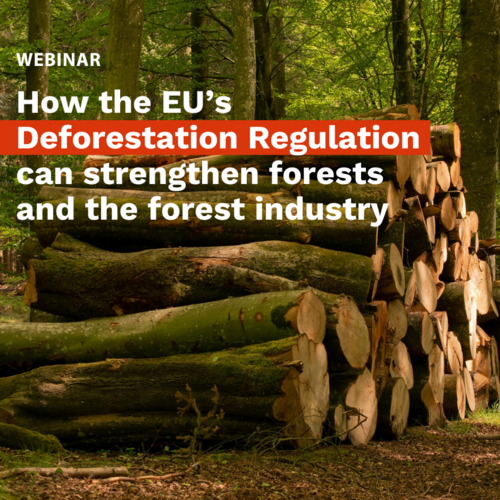
On 3 July 2025, Fern hosted a webinar focused on ongoing preparations for the EUDR as well as investment and outstanding asks from those in the wood supply chain.
Representatives joined from a wide spectrum of relevant industries, from Anders Tivell, Swedish forest owner, to Pieterjan Desmet, CEO of Decospan, a wood veneer processing group, to Anand Punja of the Forest Stewardship Council (FSC) certification scheme. It also gave voice to those who will be tasked with supporting enforcement - Tara Ganesh from the NGO Earthsight and Jan Doubal from the Czech Competent Authority, which has also been supporting small forest owners to comply.
Many have invested in compliance
Across the timber industry there are companies who have prepared, postponing gives them a competitive disadvantage. As Decospan emphasised, “Our group always have been having a very proactive approach on the EUDR. Last year, the whole group was ready for that. All the investments have been made to be a proactive company, as a lot of the Europeans are. And then, of course, postponing gives us a competitive disadvantage compared to other companies who did not do that.”
FSC intervention showed there is support for these companies. “We're heavily investing in our digital infrastructure. Blockchain is part of that for the traceability aspect as well, but we also expect our risk assessment platform to be available in the next month or so.”
Competent Authorities are getting ready to enforce. As Jan Doubal pointed out “Many of the Competent Authorities have started adapting way in advance, funding has been wrapped up by companies, and they are ready for the challenge at hand.”
Clarity is urgently needed for businesses
Pieterjan Desmet from Decospan stated: “It's very, very important that it's clear, otherwise we will lose momentum. Without clarity, you lose traction and credibility in the system. Clarity is needed to go back to our suppliers to prepare. In Europe, that's not difficult to convince the people, because everybody is pretty well aware of what's coming. If I look at overseas areas, I need clarity, so we can go back at the table with our suppliers.”
Data required from foresters and forest owners is easily accessible, many are getting support to submit it
Jan Doubal gave an inspiring example of how the Czech Competent Authority is supporting small forest owners.
“We have all the forest management plans digitised. The only difficulty is to give this information to the small forest owners, or forest owners to provide it into the information system and make it part of the due diligence. Some forest owners are not using the advanced technology, but I think that there is also a role of the Competent Authorities or Member States to support the small forest owners to get this information correctly when it exists. And we are focusing on providing the information directly to the forest owners. This publicly available geoportal will include also forestry parcels.”
Anders Tivell spoke as an owner, explaining that he already has the required data: “The information required on location, volume of timber and species is easily accessible to me. Many forest owners in Sweden already share this information with the forest agency to get authorisations for doing logging.”
For many forest owners, including Anders, logging contractors will be uploading logging due diligence statement for them. However, Anders also warned against excessive focus on technicalities, insisting that the importance of the EUDR rested in its goals, which tools should be made to align with.
“This is just a tool for working with a much bigger issue of deforestation. If a tool is not good enough, then sharpen it. To me, this is a non-issue. The important issue is to retain resilience.”
The EUDR is an opportunity to increase the resilience of European forests
Given recent EEA data stating that the European carbon sinks collapsing, Anders highlighted how the EUDR will help European forests in the face of climate change.
“We are forced to abandon the narrow focus on volume production. Because of climate change. Today, we can see more wildfires. More frequent and longer droughts. And forests being destroyed by insect attacks. An example is Germany, where in 2018, 1,200 square kilometres were affected by spruce bark beetle. Resulting in huge economic losses. These disturbances are, of course, a result of climate change. But the extent of destruction is the result of plantation forests. Being very vulnerable and lacking resilience.”
“Without the EU Deforestation Regulation, existing resilient primary and naturally regenerated forests will be transformed into these vulnerable plantations. And that's why I find it so extremely important that this regulation is coming in place.”
Maintained ambition and strong enforcement are crucial for the health of the European timber industry
Tara Ganesh explained how the EUDR was designed to alleviate the failures of the EU Timber Regulation (EUTR).
A key component is minimum enforcement checks. Another is geolocation requirements in due diligence, which is crucial for enforcement.
“The EUTR also required due diligence statements to be lodged but without geolocation. Under the EUTR currently, it can be requested on a case-by-case basis, but under the EUDR, that will be available to accompany shipments as a matter of course. This geolocation data obviously equips Competent Authorities with key information to compare harvest locations to declared volumes and species. [Without geolocation] Competent Authorities wouldn't be equipped with the tools they need to debunk false origin claims, which we've seen.”
Anand Punja of FSC explained how “the core of EUDR is about due diligence, and that is about risks, and assessing and mitigating risks. And in our experience as an organisation across 30 years, the hundreds of staff, thousands of staff that have worked for us, of years of experience of working in that forest governance area, there isn't really a country in the world that doesn't have some sort of risk.”
Maintained ambition and strong enforcement in all Member States is necessary for a strong European timber industry.
As Jan Doubal pointed out, “We really need to work together on harmonisation, the Commission and the politicians. If the implementation is not harmonised in the whole European Union, then there will be loopholes and possibilities for the operators to bypass the regulation, and we see it day by day, and especially it was mentioned on the example of plywood and the no-risk category, for example, for sector companies.”
Tara Ganesh strengthened this point: “Europe is currently very exposed to illegal timber, and it undermines businesses who are genuinely attempting to source from sustainable forests. And also EU-based producers who might be competing with illegal imports. So, for example, major European plywood producers and companies have made an effort to diversify their supply chains. And they're competing with illegal imports of products from outside of the EU.”
Support for readiness and enforcement is the only way forward, providing fairness, respect and security for the wood supply chain and European forests.
Hannah Mowat, campaigns coordinator at Fern, spoke of the importance of respect to those who have been preparing and providing support to prepare for foresters and forest owners.
She emphasised the importance of security for timber supply chains, which is what the EUDR brings by disincentivising degradation of European forests.
It is important to be fair to those who are prepared, those who have invested and those who buy and sell legal, sustainable European timber. Because eliminating cheating and unfair practices – in particular from Russia - is an opportunity for European wood.
Categories: Events, EU Regulation on deforestation-free products