Restricted areas from mining
Article available in:
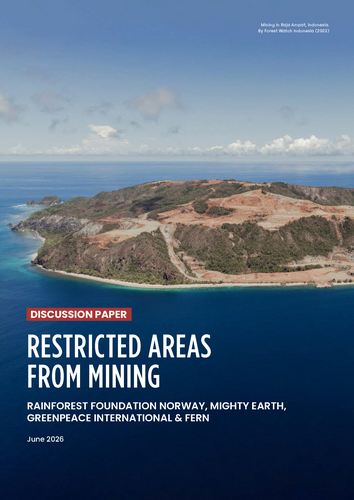
The rush for critical raw materials needed for the energy transition, digitalisation, Artificial Intelligence (AI) boom, and the military sector is posing a threat to natural forests and some of the planet’s most important ecosystems.
The nickel boom is devastating small islands and forests in Indonesia, cobalt extraction is destroying the Miombo forests in DRC and recent research shows that the expansion of mining threatens conservation of protected areas in the Brazilian Amazon, which consist mainly of forests and shelter about 195,000 traditional people, including Indigenous and Quilombola communities.
Europe, too, is desperate to secure its own supply of critical raw materials. To do so, the European Commission selected 47 Strategic Projects sites where procedures for mining for key metals and minerals will be streamlined. One site not among those added to the list, but nevertheless attracting controversy is the Sakatti mining project in Finnish Lapland, where an ecosystem that’s evolved over thousands of years, and awarded protected Natura 2000 status, recently moved a step closer to opening.
Many of these minerals are in biodiversity hotspots which overlap Indigenous and peasant peoples’ lands.
To prevent it, some places on earth must be declared off-limits for mining under any circumstances.
This argument – and the criteria for determining these places – are laid out in detail in this discussion paper developed by Rainforest Foundation Norway, Mighty Earth, Greenpeace International and Fern. It is accompanied by a global Restricted Areas Map for transition minerals mining defined by Greenpeace International to identify areas with high ecological, natural and social values that should be off-limits to extractive activities such as transition mineral mining, in order to move the Earth's trajectory to one that limits global average temperature rise to no more than 1.5-degree Celsius while also respecting other crucial interconnected planetary boundaries as well as the rights of Indigenous Peoples and Local Communities.
It underlines the currently fragmented and inconsistent approach to protecting human rights and the environment from the ravages of mining for critical raw materials, along with major regulatory and accountability gaps.
It is these failings which have enabled mining projects to go ahead in locations and ways “that inflict irreversible harm on people, their ways of living, ecosystems, and the climate”, the briefing argues.
There is, therefore, an urgent need for a unified approach. The first step to achieving this is reaching a shared definition for the ‘Restricted Areas’ where mining should be off-limits, on land and sea.
This should be grounded in internationally recognised environmental and human rights protections, such as the IUCN, UNESCO and the Ramsar conventions, and include areas of High Conservation Value and High Carbon Stock Areas, as well as Indigenous Peoples’ territories. And of course, mining operations should be forbidden if they do not have the Free Prior and Informed Consent (FPIC) of Indigenous Peoples’ or local communities.
Categories: Reports, Critical minerals
Downloads
 Restricted areas from mining (1.63 MB)