
Centre pour l’environnement et le développement celebrates its 30th anniversary
10 Desember 2025
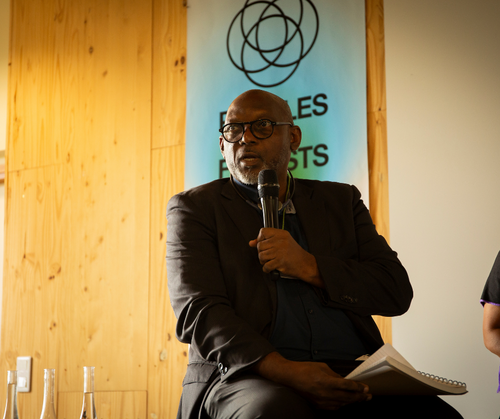
As the Cameroonian NGO celebrates its 30th year defending forest peoples and forests, founder and longest-standing Fern partner Samuel Nguiffo looks back on the CED’s evolution.
We have had the good fortune, sometimes, to be listened to, and to provoke some change.
In the complex context of 1990s Cameroon, it was never a given that a tiny environmental NGO was going to stay the course. It was still less obvious that 30 years later, the Centre pour l’environnement et le développement (CED) would become a respected grain of sand in the cogs of well-oiled political machinery, and a mentor to other NGOs. Founder and lawyer Samuel Nguiffo reflects on how, against a challenging backdrop, CED forged a path for other organisations.
Early days
In the early 1990s, outside forces steered Cameroon towards environmentally damaging outcomes: International Monetary Fund and World Bank austerity measures led Cameroon to reform its Forest Code to treat its tropical forests as a commodity, and to make them more attractive and accessible to foreign investors. Timber concessions were lengthened to 30 years, massive 200,000 -hectare stretches of forests were made available for felling.
A further legislative mishap set the stage for illegal logging: requiring applicants for a timber licence to prove processing capacity (i.e., a wood-processing plant) did not guarantee a licence; after making this substantial investment, many companies were left with no concession and therefore sought to find logs by whatever illicit means possible.
At that time, to create domestic non-governmental organisations (NGO) was an arduous process requiring that each member undergo character investigations by the national intelligence services. The rare NGOs that existed were often religious, centred on health, education and development.
None ventured out onto the thin ice of political criticism of environmental policies.
A meaningful forest trip
Three friends in Yaoundé had followed the growing international debate around environmental issues, and began asking themselves how to transpose the debate to Cameroon’s challenges. They took worried note of the hellish cadence of trucks stacked with logs trundling through the city and wondered what was happening to vulnerable peoples in faraway forests.
“We could see that logging was intensifying. But this was occurring in forests distant from the main urban centres of Yaoundé and Douala, that few people had the opportunity to visit or verify what was happening there – from time to time the media published articles, but they too had not carried out any investigations or systematic analyses,” Nguiffo says. “We decided to go to the source and see the conditions of production and eventual problems for ourselves.”
They spent a month in the forest listening to the concerns of all involved.
We were welcomed by communities and local officials, religious organisations – people who shared their fears, what information they had, rumours and suspicions …. Even certain forest operators received us and explained the functioning of logging operations. We met the two main peoples, the Bantus and the Pygmies, and saw their deep attachment to lands and forests.
We understood that logging represented a profound threat for these peoples. No benefit-sharing took place. Whatever rare jobs available in their villages were truly menial, unskilled jobs – low wages for precarious employment.
Back in Yaoundé
Among the newly formed NGOs dealing with environmental issues, none wanted to touch the issue of forests.
With rumours swirling about the direct involvement of political elites in Cameroon and France in the timber trade, it seemed too dangerous for young organisations with few political friends. But we had seen communities whose environment and natural surroundings were profoundly disrupted by logging activities, knocking their way of life and livelihoods off balance. For us, the starting point was primarily social. Stopping the destruction was an essential means to keep the harmony between these peoples and nature.
In this vacuum, in 1995, they decided to create the CED. Finding no one willing to work with them, Samuel Nguiffo was assigned the task of starting the organisation.
Friends in Europe
Nguiffo quit his previous work and used personal finances to visit the countries towards which Cameroonian timber was exported: Switzerland, Germany, Belgium, France, the Netherlands, armed with a list of like-minded NGOs. In France, where most logging companies operating in Cameroon originated, environmental organisations were also just starting out, mostly with volunteers who also had income-earning jobs. In other countries, the environmental movement was quite well established, running strong forest campaigns, but because of the lack of African contacts, the focus was largely on the Amazon or Southeast Asia.
“That’s what I brought to the table.” A chance mention at a Forest Movement Europe (FME) meeting motivated Nguiffo to juggle return plans and extend his stay. At that FME meeting he met, among others, Fern founder Saskia Ozinga. Starting out at the same time, Fern and CED became natural partners.
It was a godsend to have all these organisations gathered in one place, so I could explain what brought me. Very clearly, NGOs in countries of timber origin and timber consumption needed to cooperate and share information about the logging companies – who owns them, their sources of funding, whether the state or public banks provide money. CED wanted to know who consumed the timber to understand how to share relevant information for advocacy, but also how we could use it on our side. Establishing relationships with these people, these groups, was extremely important for us.
As CED’s work got underway
Navigating the absence of a civil society culture proved delicate. CED were welcomed by local communities who, unaccustomed to people listening and working with them, remained wary. “Some felt we were building trust for a possible hidden agenda. They had no reference for individuals who worked in the service of a cause, in their interest.”
Authorities also suspected CED of a hidden agenda, of hiding political opposition behind environmental and social concerns. Relations worsened as CED’s profile grew.
“We realised that we were probably doing something useful because we were violently attacked – often verbally, but also physically. Armed ‘robbers’ visiting me at the office, but surprisingly stole nothing but my passport, a few days before an important meeting in Washington,” Nguiffo says. “We were also victims of a few cases of burglary during these years."
When we started publishing, being critical, ringing a different bell and relaying what people in the villages were thinking, companies and officials quickly turned against us. We were requiring them to think about things they had not considered – limits of sustainability, peoples’ rights, pushing them to justify actions – they weren’t used to all that.
We became the grain of sand in the cogs of a well-oiled machine that halted their trajectory – and that made us happy, because the machinery was not working for the communities. We could see how the communities relied on us, how they brought us their problems. We forged genuine friendships with them that have never stopped. They truly continue to this day.
Strengths and achievements
Attentiveness and an ability to be early identifiers of emergent problems are among CED’s strengths.
We saw forest conversion – now considered a principal threat – as menacing even in its infancy. We understood early that land tenure was a foundational issue, that the rapid expansion of mining was a direct threat to forests.
But early on, without strong scientific studies, the destructive nature of logging was very difficult to prove. Shifting the debate to the illegal nature of exploitation changed everything, as illegality was easily demonstrated by holding activities up to the laws in force.
Asked specifically about CED’s proudest achievements, Nguiffo first stresses the acceptance of local communities, and the trust that the most vulnerable peoples have placed in CED.
More eye-catching successes include a battle that a handful of NGOs – CED, and partners in Chad, France, Germany Switzerland, the Netherlands and the United States – took up against sub-Saharan Africa largest project, a pipeline between Chad and Cameroon, developed by a consortium led by the world’s then largest company, ExxonMobil. Although that devastating juggernaut could not be stopped, NGOs fought for four years to put in place much higher environmental standards and hold the consortium to them, and to require better community compensation.
He forgets to mention that he was a 1999 Goldman Environmental Prize laureate, but we at Fern haven’t forgotten.
The road ahead
Perhaps the most far-reaching success, and biggest source of pride, has been CED’s role as an environmental pathfinder. Early on, CED realised that it could not solve all the problems confronting forest communities if it remained alone in the field; it needed to help create other organisations willing to join the fray, and to grow with them. CED focused on training young people with no experience, especially young lawyers, but also sociologists, geographers and other specialists in issues of community and environmental protection.
“We recently had fun checking up on names and found that some 150-200 young people who came through CED went on to have strong careers all over the world. When I run into them, many say that their time at CED was exceptional.”
Over the years, CED’s influence has grown far beyond Cameroon’s borders. “We worked with Nigerians and Chadians on oil, we worked with other Congo Basin countries on forests and gold, we worked with the groups from both Congos on forests, Indigenous Peoples, cartography and, of course, extractive industries. We built capacities of local and national NGOs, community leaders and experts of tomorrow with the Gabonese people – we have helped to build capacity in each of these countries.
Today we are looking to the problems stemming from land-use saturation and the overlap of all manner of investment on the same limited lands. We see the requirement of restoration as a response to such conflicts.
Nguiffo adds, “Overall, we have had the good fortune, sometimes, to be listened to, and were able to provoke some changes significant to communities.”
Image: Mídia NINJA / Flickr
Categories: News, Forest Watch, Partner Voices, Cameroon