Forest Partnerships in focus
27 Januari 2026
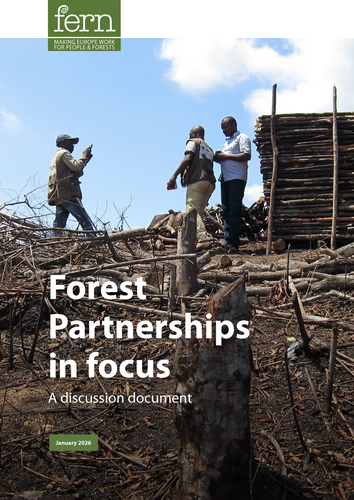
This desk research examines the content of the Forest Partnership Agreements (FPs) that have been developed by the European Commission in seven countries (Republic of Congo, Uganda, Zambia, Honduras, Mongolia, Gabon, and Guyana) since 2022.
Forest Partnerships are umbrella agreements aiming to coordinate EU and Member State activities related to forests in a partner country. These agreements differ greatly from the EU’s historical forest partnerships such as Voluntary Partnership Agreements (VPAs) under the Forest Law Enforcement, Governance and Trade (FLEGT) programme.
FPs are non-binding agreements, their content varies from country to country and expands beyond the forestry sector to include activities encompassing agriculture, mining, legal reform, carbon markets and broader economic development objectives. Their activities often take place within the framework of other political processes and programmes, making them difficult to track. They remain largely misunderstood by key stakeholders, yet seem to become increasingly important in the EU’s forest governance toolbox. For instance, in some highly forested countries (such as Liberia and Cameroon), longstanding agreements that focus on forest governance (VPAs) are being terminated and FPs proposed instead.
The research outlines issues and recommendations, which we have summarised and added to below:
-
Democratic deficit: Contrary to other trade or partnership agreements, Forest Partnerships do not include a formal role for the European Council or Parliament.
We recommend building pathways towards a formal oversight role of the European Parliament and Member States to ensure broader buy-in and support. This could notably be done by revising the FLEGT working group terms of reference to include the requirement to provide updates on Forest Partnerships and to include Civil Society Organisations (CSOs) from Forest Partnership countries.
-
Multistakeholder participation: Local civil society and Indigenous Peoples and Local Communities (IP&LC) are only awarded ad-hoc consultative roles. The lack of formal spaces for multistakeholder participation prevents the establishment of checks and balances that are essential to good governance.
We recommend leveraging existing multistakeholder groups to ensure that CSOs and other actors can play a strong and active role in Forest Partnerships moving forward, as well as setting minimum thresholds for funding to support CSOs and Indigenous Peoples and Local Communities (IPLCs).
-
Transparency: Forest Partnerships focus on boosting investment opportunities following the EU’s Global Gateway investment approach. However, the associated budgets are not sufficiently transparent (and are sometimes entirely absent), which means accountability is low and risks undermining inclusive development.
We recommend publishing regular aid memoires of Forest Partnership meetings as well as road maps, budgets and detailed action plans with clear indicators.
-
Policy coherence: Forest Partnerships contain ambition for necessary legal and governance reforms. However, achieving these is often reliant on binding processes, structures that sits outside core infrastructure, such as FLEGT VPAs.
We recommend that Forest Partnerships articulate how they co-exist with other forest related initiatives and funding streams.
Without transparent budgets, meaningful multistakeholder participation, democratic oversight and clear coordination with complementary forest governance processes, FPs risk falling short of their objectives.
Categories: EU Partnerships, Cameroon, Liberia, The Republic of Congo
Downloads
 Forest Partnerships in focus (4,65 MB)