Intensive forestry lobby wants to legalise the killing of breeding birds
15 Oktober 2026
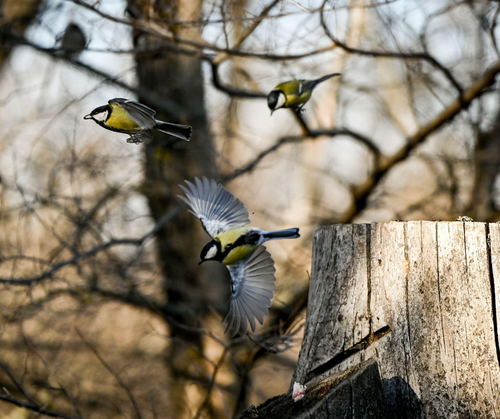
At a time when legislative bodies prioritise commercial interests over broader public interests, only the judicial wall seems to be holding. Commercial actors are responding by searching for ways around judicial safeguards – such as protections for falling bird populations. In September 2026, the intensive forestry industry proposed using a dangerous draft regulation to gut EU prohibitions and caselaw concerning logging during breeding season.
For decades, the EU Birds and Habitats directives have prohibited the intentional killing or disturbing of nesting birds and the destruction of their eggs. It was not clear whether harm caused by logging trees while birds nest is to be considered intentional - until recent judicial decisions brought clarity which the forestry lobby finds burdensome. They now want forestry to be permanently exempted from the obligation to consider impacts on nesting birds.
In August 2025, the Court of Justice of the European Union (CJEU) issued a preliminary ruling (C‑784/23) in response to a request from Estonia’s Supreme Court for instruction concerning the legality of felling in a bird-dense forest during breeding season. As it had previously (C-473/19), the CJEU stated that logging during breeding inevitably causes nest loss and bird mortality and must therefore be considered intentional under the Birds Directive. It confirmed that breeding season protection applies to all bird species, no matter the population size or conservation status and, referring to the precautionary principle, stated that scientific data, field observations and forest features can provide a basis to estimate density of breeding pairs. The CJEU limited its ruling to the bird-rich Estonian forest in the case.
Applying that ruling, the Supreme Court of Estonia, 19 January 2026, dismissed the logging companies’ appeals, rejected compensation claims and confirmed the lawful suspension of felling during the breeding season in the forest concerned. It referred to the 10‑pair density as sufficient to establish intent, leaving some uncertainty about intent in less bird-rich forests.
These developments upset intensive forestry actors. Clearcutting in spring and early summer is not part of forestry traditions; it has been pushed only since clearcut forest management made implementing a logging pause costly and complicated, inciting foresters to compromise their traditions.
With court rulings threatening year-round logging, intensive foresters are seeking to influence political processes to make disturbing and killing birds by logging while breeding legally acceptable: the Environmental Omnibus and, within that package, a proposed Regulation on speeding up environmental assessments. Although the proposal’s proclaimed intent is “to speed up and simplify procedures without compromising environmental protection or assessment quality”, it is poised to untether forestry activities from liability if they fail to ensure that birds do not suffer during logging operations.
EUSTAFOR, CEPF, Copa-Cogeca, ELO, EOS and FECOF1 go even beyond the above Commission proposal and Council opinion: they wrote to MEPs, 29 September 2026, to ask them to exclude also “deterioration or destruction of breeding sites and resting places” from logging impacts “provided that the relevant Member State authority has determined that the plan, project, works or recurring activity includes appropriate and proportionate measures […] to avoid such deterioration or destruction.”
That might be understandable if Member State authorities had a history of protecting birds and forests, but the opposite is true. We are seeing the race to the bottom in forest regulation, even as the Common Forest Bird Index is in decline, and forest habitats included in the Habitats Directive remain in an unsatisfactory state. This is particularly the case in Northern Europe where clearcut-based forestry dominates.
1. In order: European State Forest Association, Confederation of European Forest Owners, Committee of Professional Agricultural Organisations and General Confederation of Agricultural Co-operatives in the European Union; European Landowners' Organisation, the European Organisation of the Sawmill industry, and the Fédération européenne des communes forestières.
Image: Ukrinform | Alamy
Categories: News, Forest Watch